Sunday, August 23, 2009

Highlights from the 2009 Alton Jubilee Parade


A warm balmy day met the prayers of those who had planned this year's annual Alton Jubilee, held on Saturday, August 22nd in the small town of Alton in Osborne County, population around 110, maybe 115. The temperature reached a perfect 82 degrees with winds of less than 10 miles an hour. This made for one of the best celebrations in recent memory. At 10:30AM the crowd was seated and anticipating the annual parade, traditionally always the best in the area.


This year's parade theme was "Generations to Generations," and several floats reflected this theme with four and - even five generations - of family members aboard!


The Boland Body Shop was proud to note that it was "Open to ALL Generations!"


The Stockbridge-Carswell families float featured photos of the family farm through the years, from 1943 to the present day.


The Sharpe Memorial Clinic of Osborne used a patriotic theme.


John McClure of Blue Hill Bikes in Osborne reminded everyone that the weather was perfect for such activities.

An annual tradition is for the Osborne High School cheerleaders to ride on the fire truck.
The Bull City Opry enjoyed promoting their melodrama to be portrayed later that evening - "The Cowboys & Mrs. Hoodwinkler."

After the parade it was time for the hungry crowd to find something to eat. Inside Hardman Hall the annual homemade ice cream & pie feast proved once again to be a true feast for the eyes. Getting past this table of slices of pie proved to be very difficult for most. And then they were stumped with the choice between five different kinds of ice cream!

A shot of just part of the long line of hungry visitors awaiting their turn at the traditional hamburger feed fundraiser for the Alton Fire Department. As usual, no one complained at the wait but seized the time to talk and catch up on the world with their neighbors.


There were two author book signings going on in the afternoon. Here Kelli LaRosh signs yet another copy of her popular childrens book, "What's Math Got To Do With Farming?" published by Ad Astra Publishing LLC of Osborne, Kansas.

That evening the annual barbecue proved so popular that a crowd of over 400 caused the food to run out. Even the melodrama - a "Bring Your Own Lawn Chair" event held on the city park tennis court - attracted a record crowd. Be sure to mark your calendar and attend next year's Jubilee!

Friday, August 21, 2009

A Domestic Tale

I never will be accused as having a "green" thumb. If anything, I will eternally accused of "not watering your plants enough again, huh?." But many who know me reluctantly admit (some very reluctantly) that I can do one thing right - I apparently can do wonders with a dumb cane.

Dumb canes originated in Brazil and for the past 150 years or so have been a popular house plant - as long as you keep pets and children away from them, as the juice of the dumb came is rather poisonous and is not something you would want to ingest. But give them a little plant food periodically and a lot of water often and they generally take care of themselves.

Family memories place my mother acquiring a dumb cane plant somewhere around 1967 or 1968 or thereabouts, and the plant remained a fixture in her living room for nearly 35 years. In 2001 I inherited the plant and to my enduring astonishment managed to keep it alive all this time. Then this past week something occurred that had not happened in the past 40 years: the dumb cane flowered!


Asking around, this turns out by everyone I know to be an unheard-of event. Checking the Internet simply showed photos of flowers everywhere with the implication that this happens all the time. At any rate, it took a day for the flower to fully open, as the above photo shows. It then slowly closed over the next day-and-a-half, but not before a SECOND flower started growing!


It took the second flower two days after the first to mature and open, and then presenting me with a second surprise: in the twilight of the evening the flower suddenly emitted an odor that would make a skunk proud. It turns out that the dumb cane really is a distant cousin of the skunk cabbage. It was easy to believe that the plant was releasing 40 years of pent-up scent. The stench was so intense that I quickly became nauseous and ended up banning the plant to the back porch, where it continued to emit its offensive odor the rest of the night. Evidently I inhaled too much as it took another day for the sick feeling to finally pass altogether.

Two sources on the Internet suggest that after flowering a dumb cane plant will die. I hope not, but after getting a potent whiff of this plant, I frankly won't be surprised.

I took the second photo above of the second flower just before the flower released its intoxicating/toxic pheromone. In the photo you can see at left the first flower curled up tight. At the right is the open second flower. What is between the two is my new concern. Yes, it appears that a THIRD flower is growing. What surprises does it have in store? I checked - not even the Internet knows.

Sunday, August 16, 2009

Three Stories of Race, Age, and Politics

Traveling along U.S. Highway 24 in western Osborne County, Kansas, one normally continues unawares west down the highway and then enter Rooks County. That's fine, as there is a lot to see and do in our fellow county to the west. But in doing so, you'd be missing out on Exploring a relatively small area along the western edge of Osborne County that is chockful of great little stories, all which add to the overall understanding of Kansas history and culture and thus are well worth the retelling.

Travel four miles west of the city of Alton on U.S. Highway 24 in Osborne County one can spy a quarter mile south of the highway another one of those great rural cemeteries that dot the county - the Pleasant Valley Cemetery.
Back in the 1980s the money and materials were gathered to go through the cemetery and use temporary markers and a little concrete to mark several burials that otherwise would now be long forgotten. The simple words on the marker above never fail to grab a visitor's attention. Negro Hattie [died] 1904. One cannot help but wonder, who was this person? How did she come to be here?

A couple of questions here and there locally and the few barebones left of the tale of Hattie come forth. Born a slave, after the Civil War Hattie worked as a servant for white families. She came to Kansas and Osborne County in the early 1870s and worked locally for the Strange and Deering families until her death on March 5, 1904, unsure of her exact age but still remembered over a century later as having a great laugh and for being full of life. Not a bad epitaph in the end.
In walking through the Pleasant Valley Cemetery the above stone seems not much different from many other tombstones of the era seen there - aged, broken, and slowly disappearing into the ground. But closer inspection of when Naomi passed away brings up a surprising fact: when she died was 87 years old, which means that she was born in the 1790s.

Now, further east of Osborne County it no doubt becomes commonplace to find the final resting place of someone from the 1790s. But in this county, the number of such graves can be counted on one hand. Add to that the even more astonishing fact that 79 year-old Naomi claimed a homestead when she arrived in the Pleasant Valley neighborhood. Stop and think on this. How many 79ers you know today would have the ability, courage, and sheer energy to set about creating a farm from scratch?

Her life story is no less courageous. Naomi Sly was born April 9, 1792 in Vermont. At the age of seven she moved with her parents to Ontario Province in Canada. In 1811 the 19 year-old Naomi married Archelaus Farnam, subsequently becoming the mother of seven children. When the youngest child was three years old the husband died, leaving Naomi alone to support her family. She did so by working in turn as a miller, a seamstress, and a weaver. All seven of her children reached adulthood.

In 1867 Naomi and her son Jonathan sold their property and moved his family to Nebraska. In 1871 they moved on to Osborne County, where Naomi and Jonathan took out adjoining homesteads. The next year Jonathan died, leaving his widow and Naomi to develop the two homesteads and raise the eight Farnam children. In 1873 Naomi sold her land for one thousand dollars, an enormous sum in those days, and so helped the Farnam family establish a long term presence in the area. She passed away in 1880 at the respected age of - as her tombstone states in the manner of the time - 87 Ys, 9 Ms, & 18 Ds.
Two miles northwest of the Pleasant Valley Cemetery can still be found a stone farmhouse that belies its importance. For this was originally the home of Russell Scott Osborn, who had a hand in one of the more wild and wooly moments in Kansas history: the Legislative War of 1893.

Osborn was a Civil War veteran who after the war was ordained a Congregationalist minister. He homesteaded here in 1872 and organized a number of Congregational churches in the region. Osborn was also a stonemason and built many of the stone buildings in the area, including his own impressive 1873 house.

He was also busy as a spokeman for farm politics, and attained such statewide respect that he was elected Kansas Secretary of State in November 1892 on the Populist Party ticket. As Secretary one of Osborn's many duties was to formally read the roll for the Kansas House of Representatives at the start of the legislative session in January 1893. In this manner the various representatives officially took their seats. As the Republican Party held the majority of seats, Osborn refused to read the roll, thus allowing the Populists to claim majority, as some election results were still being contested.

With no one formally in charge, the House was in an uproar. Both parties elected a Speaker of the House and tried to conduct business. On the morning of February 15, 1893, the Republicans tried to get back into the House chamber, but were denied entrance by the Populists, who had barred the doors and insisted that they were now the legal representatives. The Republicans used a sledgehammer to smash open the chamber doors and evicted the Populists by force. The governor called out National Guard troops to restore order, and eventually the Kansas Supreme Court ruled in favor of the Republican Party. In time Peace and new chamber doors reigned at last once more over the House chamber.
Osborn served out his two-year term and then stepped down from public office. In 1898 he returned to his farm in western Osborne County, then moved to Stockton, Kansas in 1904. Osborn died there in 1912 and was buried next to his wife in the Pleasant Valley Cemetery.

A biography of Osborn using his own diaries and other writings is due for publication by Ad Astra Publishing in the spring of 2010. It is sure to provide new insights into this unique and fascinating event in Kansas history.

Wednesday, August 12, 2009

Two Towns and a Tree

This past Tuesday, August 11, 2009, I attended a meeting at Inman, Kansas at the Kansas Sampler Foundation headquarters. The meeting was over fairly early and I was left facing most of an afternoon and evening in which to Explore the backroads of Kansas on my back home ot Osborne.


I took county roads from Inman north, then west, then south, and again west and ended up in the town of Alden, Kansas, population larger than I thought. This is one of those great little Kansas towns not located on any highway, and one I had not been back to in 29 years, when I helped make deliveries to the local cafe.

The downtown was quiet when I traveled through, but still as neat and clean as the rest of the community.

When you arrive a littler earlier in the afternoon chances are that you can stop at Alden's 1872 Depot Museum, a fine building displaying the pride this community still has in itself.

I then traveled west and north on a great county road that had stretches of wide open spaces interspersed with winding tree-lined curves. A classic Kansas Back Road!

Within a few miles I arrived at my destination - the community of Raymond, even smaller than Alden but still as neat and clean. This is a town that I had never been to before but had heard about all my life, as an aunt & uncle of mine farmed in the area for years. Driving the downtown area today one can still discover small town gems such as the Fire Department, seen above.

At the south end of the downtown area sits the former location of the Raymond State Bank. The building is still in excellent condition and is in the architectural style reminiscent of many bank buildings across the state.

Raymond was founded in 1871 and today has a population of under 100. The Raymond Post Office continues to serve the area.

A great hidden Explorer gem is the Raymond Elementary School, unique in its architectural style for a small-town school. Note the center tower-like structure!

From Raymond it was again cross-country for many miles on county roads until I made it to Wilson and the Made From Scratch Cafe. Had the homemade chicken fried steak dinner, with a tall piece of lemon pie. After waddling back out the car I headed north over the Post Rock Scenic Byway past Wilson Lake to Lucas, where having a little time to kill I decided to pull into the alley behind the Garden of Eden and up to the Chair-e Tree.

For those not in the know, the Chair-e Tree is just that - if you have an old chair and wish to contribute to great art, bring it here and artist/entrepenuer/thought-producer/ homeowner Erika Nelson will set it up and inside the large elm tree in her backyard.
Just prior to Tuesday Lucas had a major storm and the Chair-e Tree had substained some damage - or rather the chairs in it, judging from the litter now on the ground.
A wonderful Explorer swap you can now see on the Chair-e Tree: near the town of Wetmore in Northeast Kansas stands the Kissel Shoe Tree, where people are encouraged to nail their old pair of shoes and leave a message on them. On the Chair-e Tree I spied this pair of shoes, left by the Shoe Tree folks! Only in Kansas.

Friday, July 31, 2009

An Evening's Exploration of Southeast Osborne County

This past July 29, 2009 proved to be a fine Wednesday evening. So yours truly and fellow Osborne County Tourism (OCT) member Kathy Bristol decided that it was a perfect night to go forth and rediscover a stone house that had been on an OCT tour some five years before, and that Kathy wished to photograph again. Her problem: she had no longer had a clue where the house was.

We left Osborne just before 6PM, driving 19 miles south on US Highway 281, then turning east onto Osborne County Road 412. After four miles we came to one of those great backroad intersections - we could go left, following County Road 412; we could go straight, following a questionable-but-fun-looking two-track dirt/rock road; or turn right and follow County Road 685.

Right it was, and four miles south and three miles east along the Osborne-Russell County Line brought us to the mansard-roofed McGuire House. This prompted Kathy to realize why she never found this house again, with it being a good 30 miles from Osborne and yet still in the county!


Built in 1904 by homesteader John Wesley Cullens, ownership of this impressive house passed to Noah & Ruth McGuire, for whom it is still known. The home is constructed of native Post Rock Limestone quarried within a few hundred feet of the site. McGuire family reunions are still being held annually here.

From the McGuire House we drove two miles east and then 1.5 miles north to the Delhi Cemetery. The above photo comes from that cemetery and shows a sad chapter in the preservation of local history - the graves of apparently two military veterans, with bronze military markers at each grave, but no names or other information are left on the two temporary markers. The Two Unknown Soldiers of Delhi Cemetery have become a modern mystery.
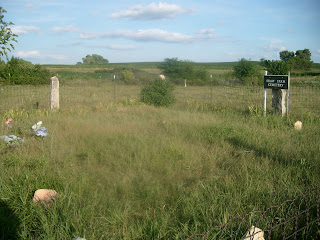
The weather being nice and the roads being dry, I then took Kathy 1.5 miles north and two miles west from the Delhi Cemetery to discover a little-known Explorer gem: the Shaw Family Burial Ground. Sitting in a pasture within a small fenced area lies the remains of up to 15 members of the Shaw family, mostly children, who settled here in the 1880s. All but one of the of the original native stone markers are now unreadable. However, within the last five years several Shaw family descendants have banded together and paid for a new fence enclosure & gate, a new sign, and a modern granite gravestone memorializing those known to rest here (seen at upper left in the above photo - with a few flowers even.

It was only after leaving this place that our real backroad adventures began. Just to the north a dirt road headed west, curving with the East Fork of Wolf Creek. It looked very good for the first half mile, then quickly deteriorated into a two-path trail with high weeds growing down the middle. Undeterred, we threaded our way along for nine tenths of mile when a ROAD CLOSED sign appeared. Yes, the second of two bridges across the meandering creek was out. This was very frustrating, because there had been no warning beforehand. So we turned around and threaded our way back east, and then north another mile. Then the loose cattle made their appearance.

Now granted, calves are pretty stupid most of the time, but the one pictured above was unusually dense. Instead of lounging in the nearby cool corn field with his other loose brethren, this one pranced back and forth in the roadway, daring anyone to bother it. I slowed down and hit the car horn, hoping that a blast of offensive noise would deter the beasty. The problem was that this was a modern car horn, the high squeaking honk of which has all the ferocity of a crying turtle dove. At first the calf looked merely perplexed, then it decided that there was indeed a need for running away, and so it took off - straight down the road ahead. We followed closely behind, hoping that it would veer off one way or another. But no, it just kept kicking up its heels and fleeing steadily north.

Finally tiring of this game I dared to drive up along side and honk at it some more. After eyeing our car as if it could not believe seeing a turtle dove that big, the calf did indeed finally turn left - only to run smack into the barbed wire fence there, bounce off, and then proceed to bawl at the cruelty of the wide world. I here and now apologize to the owner of this errant animal for running it for a quarter mile and so causing it to lose that much more weight. Let's hope that they apologize in turn for raising such a stupid animal.

Having gone that far north we continued to the next intersection and then turned west for two miles along dirt roads and fine backcountry. The ponds were full, the crops green and lush, and the beckoning hills beyond were even green this late in summer. Then Kathy yelled STOP! and we screeched to a halt. There are more stone structures, such as the house shown above, dotting the countryside in Osborne County than many would think; unfortunately, most of them are now abandoned like this one. Except for the decaying coyote/wolf/whatever deterioating on the side porch, the house looked to be in good shape and apparently was lived in until only recently.

After a few photos we headed into Jackson Township and lo! we actually arrived from the west at that interesting intersection I mentioned earlier, coming up to it while driving ON that questionable-but-fun-looking two track dirt/rock road. Dare to Do Dirt!

Back on a nice rock road we passed on west and arrived at the Cheyenne Cemetery. It took us about 45 minutes to photograph the approximately 280 headstones here. The cemetery and nearby former community were both named for the ancient Cheyenne Indian Trail, which once ran from Texas to the Dakotas and passed just to the east of the cemetery.

Off to the east a rainbow lit up the sky as the sun slowly headed down. Nothing like being in a cemetery at twilight!
We were about a quarter of our way through taking pictures when we came upon the recent skin of this author's main cemetery antagonist - a western rattlesnake. Needless to say we checked out the immediate area very, very well before proceeding.

The tombstone for James J. Earnest displays one of those classic epitaphs you always hear about but never thought you might actually ever see: A Gentleman and a Scholar.

This Modern Woodmen of America fraternal organization headstone for Ruth Parker is striking for its attention to detail, especially on the sides of the log.

The photo does not quite show it, but even the circular rings in the wood are even recreated, along with the axe split in the top!

This native rock stone is now one of many gravestones that are no longer readible.

This photo is for Kathy, who fell in love with the name Lillie Daisy.

And sure enough, three-quarters of our way through the cemetery we came across the rest of the snake's skin. We quickly finished up taking our photos and left the peaceful cemetery to its slithering denizens.

A mile south and a mile west of the cemetery brought us to one of only ten one-room schoolhouses in Osborne County that still remain on their original sites. Whitaker School, or more formally School District #90, was formed in 1879 and disbanded in 1946.


Literally a wooden shell of its former self, the school is no longer safe to enter. But looking in through one of the windows one can still see the remains of a piano that was allowed to sit and deterioate in the middle of the floor.

A one-room school such as this would have handled an average of 20 students through its 67 years of existence. Now all that remains are the memories.

Here Kathy can be seen looking one of the school's windows. She suddenly spied something interesting and went rooting for a handy stick with which to fetch it.

"It" turned out to be a green pop bottle and three curved pieces of metal that were parts the metal frame of a globe, which was also was allowed to sit and deterioate within the building. Excellent souvenirs of the day!

I took this shot of the moon over our car as we noted that the day was waning and it was reluctantly time to go on, as we had one more stop before traipsing back into Osborne.

Six and a half miles north of the Whitaker School in the Cheyenne Gap lies the site of the former community of Potterville. All that remains of this urban center are the 16 lonely headstones in the Potterville Cemetery. By the time we got there it was so dark that I had to use a flash to take photos of the stones. Nothing like being in a cemetery after dark! The stone of Richard & Julia Shull, shown above, is a good example of the stones to be found here. Once this cemetery held nearly a hundred graves. But through the years many remains were moved to other more active cemeteries.
It was not until later that I discovered that in taking the Shull tombstone photo I inadvertently also captured in the lower right of the stone the image of a no-doubt-startled field mouse, going about its own nightly business when suddenly a blundering ignorant human arrived and flashed a blinding light at it. After a frozen moment the mouse turned and scurried off. We quickly did the same.

In the evening twilight we drove back north, startling jackrabbits, pausing at the Twin Creek Farm/Rowe Dog Training Facility (too dark for photos), and finally into Osborne a little after 9PM, having driven ove 100 miles and having packed quite a lot in just three hours. And the next night we were ready to do it all over again!