Saturday, July 25, 2009

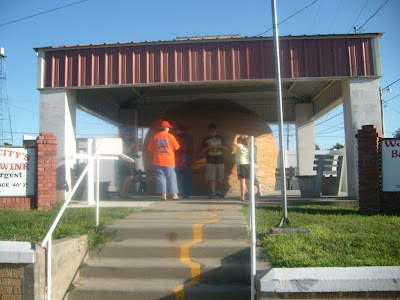
Opening Day of Osborne County Fair, Friday July 24th

The first day of the 63rd annual Osborne County Fair was one of pandemonium and slow movement as everyone dealt with entering various projects they had worked on all year on a day that reached 99 degrees. But that certainly did not stop all from having a good time!

A sampling of the artwork entered in the Open Class.

John McClure of Blue Hills Bikes in Osborne caught hawking his wares from his stall in the Commercial Building.

In the 4-H building several interested individuals pored over every one of the entries.

The 4-H club booths took shape in the relative cool of the morning.

The 4-H food had already been judged! At left, the Overall Grand Champion Oreo Cookie Bun Cake; at right, a Reserve Grand Champion Carrot Cake still plenty worthy of worship.

The 99-degree temperatures had them already lining up at the 4-H Food Stand, which saw a brisk business all day - they only ran out of ice three times!

Thursday, July 23, 2009

Just Another Typical Day in Osborne

Today was just another typical day. It started out with my portayal of an insomniac, up before 5Am, as today is the first day of the 63rd Annual Osborne County Fair, and so I began creating and printing brochures and flyers for my company's display in the "Butler Building," the local name for the commercial building in the fairgrounds as the east edge of Osborne. [Why "Butler Building?" That comes from the name of the company that built the pre-fab metal structure and is displayed prominently above the south entrance.] As co-owner of a small royalty publishing company, Ad Astra, the county fair is a wonderful chance for some local promotion. Say, if you're looking for a great gift, we certainly have a book or two you might be interested in at http://www.adastrallc.com/ . . . .


(The preceding advertisement was brought to you by me. My partner will be pleased.)

Later in the morning I met Laura McClure and Joe Hubbard, proprietors of Osborne's Riverbend Bed & Breakfast, and after erecting my display helped them to but up the display for Osborne County Tourism. This year's OCT display features our brand-new county banner and county flag, small but significant strides in Osborne County's efforts toward expanding local tourism and promotion.


There are many symbols in the Osborne County Flag, as befits the first-rate design it is. The three colors, from top to bottom, stand for the three main North American countries - Canada, the United States, and Mexico. The three stars stand for both the three countries and for the Holy Trinity. The centerpiece is a recreation of the actual bronze disk that is the Geodetic Center of North America, unique to Osborne County and one of the reasons that Osborne County is referred to as "the Center of the Continent."


Here is a quick shot of the Ad Astra Publishing display. Easy to erect, easy to tear down. Sometimes less really is more.


Later in the afternoon I met up with Laura McClure again as we presented a program at the Parkview Manor rest home in Osborne. As you can see, there was quite a crowd waiting for us!

We first showed a video and then several photos as we told of how the nearby town of Natoma is credited with inventing in 1910 a true national sport - auto polo. Young daredevils of the time stripped down Model T's to their bare frames and with each car holding a driver and a ball handler actually drove on football fields trying to knock a small ball over the opposing team's goal line. We kid you not. Check out the photo below from 1913:


As you can imagine, the game was very exciting to watch but had more than its fair share of bruises and broken bones. This next photo from 1914 shows a goal being made:


Auto polo grew into a true national rage by the 1930s as teams from New York City, Chicago, and other large cities thrilled audiences everywhere. However, World War II and national gas rationing signaled the end of the sport.

We then ended the program with a photo presentation of what there is to see and do today across Osborne County.


After that Laura and I headed to the Carnegie Research Library in downtown Osborne to spend the rest of the afternoon working as volunteers in operating the library for the local Osborne County Genealogical & Historical Society. As you can see, there is now a permanent sign welcoming all members of the Kansas Explorers Club to the 1912 former Carnegie Library, which is listed on the National Register of Historic Places. Stop by most afternoons as friendly folk will always be ready to help you with your questions and help you discover what there is to see and do in Osborne County.

Monday, July 20, 2009

The Plains: Something to Contemplate

We are in a contemplative mood this morning, and nothing is bigger to contemplate than the sheer size and grandeur of the Great Plains of North America. In this spirit I submit the following observation as noted by Kansas folklorist/cowboy eternal Jim Hoy and taken from the book Plains Folk, A Commonplace of the Great Plains, by Jim Hoy and Tom Isern, University of Oklahoma Press, 1987:

“Plains folk take space and openness for granted. It seems that most of the things we think of as typical of the plains -- barbed-wire fences, windmills, wheat fields, grass -- are things we can see through. In fact, if we can't see through something (whether a physical object of somebody's scheme), we get nervous. Most people from outside the plains, if they seek privacy when they are out-of-doors, will look for a tree or a big rock to hide behind. Most plainsmen, on the other hand, will look for the barest, highest spot they can find. That way they can see whether or not anyone is sneaking up on them.

Coronado, we are told, was never more frightened than when he looked through the legs of a bison and could see nothing but horizon. The plains must have looked as endless to him as Interstate 70 does to a westbound easterner -- four lanes into eternity.

Buffalo Bill Cody, on the other hand, thought the plains anything but monotonous. He never got lost, he said, because the plains were so beautiful that every landscape he ever saw was forever emblazoned into his memory. Mountains and trees have their attractions, but to a true plainsmen, nothing is prettier, or more reassuring, than a big sky and some wide-open spaces.”

Saturday, July 18, 2009

Photographing Tombstones, Entry 3

After the trip back from Glen Elder through Cawker City and Downs I stopped to photograph the Oak Dale Cemetery, located just a few miles to the northeast of Downs. This relatively well-kept cemetery probably has few visitors at any time, but in any rural cemetery there are some rather interesting stones - and so stories - to discover here.


This 1953 marker is to the memory of all the early settlers in the "Oak Dale District," which consisted mainly of those settlers from along both Elm and Oak Creeks.

At its beginning Osborne County, Kansas could count those of the Democratic Party persuasion on one hand. A. B. Collins was one of the of these before his death on December 6, 1872. A tree he was cutting fell on him at the age of 42 years, 9 months.

Forgive the poor quality of the photo, but Joseph Delbert “Del” Cox deserves a small moment of reflection. An early settler and historian, for 40 years he wrote the column "Across the Raging Solomon" for the local newspaper. Now THAT would be a blog!

In our rural cemeteries even the most important memories are slowly fading away. Here the best that can be done is a homemade stone saying Civil War Veteran Unknown.

When the local GAR ("Grand Army of the Republic" - the Union soldier post-Civil War fraternal organization) post was formed in the nearby town of Downs, the name of the war veteran they chose to honor was that of Benjamin Greenman. This being an honor usually preserved for the most distinguished and well known of the veterans, it is odd that very little is known of Benjamin Greenman, as this simple homemade stone shows. One of the many unfinished stories that abound in Osborne County, Kansas.

The Evening After Fun Day

Upon leaving Glen Elder's Fun Day at around 6:45PM I headed back west on US-Hwy 24. As I drove through the town of Cawker City I spied new initiates at the World's Largest Ball of Sisal Twine and had to stop and say hi. They were from out of state and were thrilled with the opportunity to add some twine to the Ball.


Another interesting Cawker City monument that many people miss is located at the east edge of the Ball of Twine. It is a marker that once denoted the site of the Gledhill Homestead & the Twelve Mile Creek Post Office along the 1870s Cawker City-Smith Center Trail. The marker originally stood approximately ten miles to the northwest of Cawker in Smith County, Kansas. Sometime in the mid-20th Century road work the "temporary removal" of the marker from that original site. For some reason after the work was finished the marker was not put back in place but rather re-erected here in Cawker City.


Driving by the historic Hesperian Library in Cawker City I see that the local goal of $20,000 has been raised toward the renovation of the building, and the final work goes on. Way to go, Cawker!

The old adage To know where you're going, You've got to know where you've been is often more true than most people realize. It's nice to see by this plant stand that the citizens of Cawker City respect their past and their town namesale, Colonel E. Harrison Cawker. Though more respectable plants in the stand might go further to emphasize that point.

Driving on west in the city of Downs stands the Sod & Stubble Monument in their city park. Newly restored, the marker commemorates the local area upon which the classic 1936 novel Sod & Stubble written about.
Then it became time to take off on some good Kansas backroads to my next destination. There's always something to see in rural Kansas!

A Taste of the Glen Elder Fun Day Parade

at 4:15 PM today my choice was either start mowing the lawn or drive the 24 miles east to Glen Elder, Kansas to take in their annual Fun Day Parade.

Some choice.

It was a beautiful day, high in the mid-80s, and with a cheeseburger in hand from the local church stand I sat down to do some people watching and await the start of the parade.

Across the street from where I was sitting is Glen Elder's pride and joy, the 1926 Norris Service Station. The National Register-native limestone structure was purposely built to resemble a castle. It is up for sale if anyone is interested.

Ah! The parade starts!

Send in the clowns . . . .

John McClure of Osborne, Kansas advertising his Blue Hills Bikes business

An interesting car, and from Beloit, Kansas, as I overheard one nearby conversation stating.

Pride on Parade

After the parade the entire community partook in a barbecue blowout in the street. All the positive qualities characteristic to small town Kansas were strong this day.

After arriving back home I discovered that my camera was accidently set on the lowest DPI setting, so many more great photographs will live on only in my memory - along with the two excellent cheeseburgers!

Saturday, July 11, 2009

Doing At Last That Thing We've Been Needing To Do

It's been over five decades since my maternal grandparents Roy and Olive Pearce moved from Hoisington, Kansas, but our families ties to that community remain strong. My grandfather Roy worked for many years as a pipefitter in the roundhouse there.

My mother Delana was the eldest of their five children, two of whom died in childhood at Hoisington. Daughter Leota (1923-1929) and lone son Dallas (1927, one month old) were interred in that city's Fairview Cemetery, their graves marked only with temporary markers.

Over the years it became one of those "things to do" that would make anyone's Bucket List: to go back sometime and place more permanent markers on the graves. My mother talked about it, my sister Sue and I talked about it, and always something or another happened to put it off.

So on this Saturday Sue and I resolved to finally take on this project. We decided that instead of obtaining two normal headstones we would create two concrete ones of our own design. My niece Katie helped us gather the needed concrete mix, sand, water, wood, buckets, rags, and two new temporary markers.


Katie and Sue put together the wood forms we would be using when pouring the new concrete stones.

From Sue's home in Salina we drove west at 10:30 AM from Salina past Ellsworth toward Hoisington. With temperatures for the day forecast to be in the high 90s and the humidity to be upwards of 200%, we decided that we had best get fortified first for the upcoming labor. So at the small community of Redwing we turned off of Kansas Highway 4 and headed eight miles north to the nearly-as-small community of Beaver, Kansas. We entered Mo's Tavern, a microbrewery and hidden Kansas treasure where the food is always good and homemade beer better. After the usual excellent meal Sue downed the Half Moon Wheat Beer and I an Elm Street Porter, and we were then good to go.

Or so we thought.

We headed on to Hoisington and on the east edge of town turned into the Fairview Cemetery. Around 20 years ago I had been shown where the graves were, and went to the same area. We looked and searched and prodded the ground, but could find no trace of the markers. This presented a real problem, as we wanted to be sure that we were placing the headstones in the right place. Not being able to find the old temporary markers meant that we needed to track down someone who could help us locate the two plots. Even in a city the size of Hoisington finding such a person on a weekend could be difficult.

So we first went to the Nicholson-Ricke Funeral Home on North Main Street, our logic being if anyone knows who could help us find burial plots in the local cemeteries it would be the local funeral director. However, they were at that moment in the middle of a funeral service, and so we had to come up with a Plan B.

On any given weekend in small town Kansas there are two other possible entities that you can approach with this kind of problem - the local police and the local library. We found the library first, and in the cool of the inside the weekend librarian was kind enough to put through for us a series of local phone calls trying to track some one down who could help. The city manager was not home and so did not answer; neither did the city clerk. The city police line was busy.

At last I asked her to go ahead and call the funeral home, hoping that we would not be disturbing the services there. The director answered and was very kind, offering to look up the two plots and meet us back at the cemetery in about twenty minutes, which happened to be where the funeral service was coming out to as well.

We thanked the librarian for her help, did a quick tour of town and met the director at the cemetery a little after 2PM. Using a 1940 map he quickly ascertained that we had been looking in the wrong place (so much for my memory) and quickly located the two temporary markers, which had been pushed down into the ground and grown over by the Bermuda grass. We thanked him and he returned to the ongoing funeral service.

With relief we unloaded our gear and began the ardous task of preparing the ground for the concrete base. The grass was thick and stubborn, the ground was rock hard and unforgiving, and the hot July sun would slip in and out between clouds to sear down upon us. It did not take long for both of us to be drenched with sweat.

After what seemed hours we had the ground dug and leveled and our two wood forms in place. We then handmixed the concrete with sand and water, poured the concrete in the forms, and smoothed them down. Then we took two new temporary markers and pushed them down into the concrete.

Here Sue can be seen decorating the poured headstones with minature marbles pressed into the cement.


This 1925 photograph shows my mother Delana Pearce, top, with her sister Leota, bottom, then not quite two years old. Leota was the age of five when she passed away in 1929.
The finished folk art-style headstones now stand above the ground several inches and so should keep the lettering safe from renegade riding lawn mowers for many years to come.

After 80 and 82 years respectively our aunt and uncle are once again being treated with the respect and dignity that all former loved ones deserve. In a few weeks we will return to remove the wood forms and leave these children to continue to rest in peace.

It now being mid-afternoon we dragged our sweat-soaked bodies into the nearby Dairy Queen and spent the next two hours drying out in the blessed air conditioning and replenishing our liquid-parched bodies before heading back to Salina satisfied with a job accomplished at last.