I had contracted to lead a Historical Walk as part of the Meadowlark Storytelling Festival, the state's official such event and the largest, at 3PM on Friday, April 23, 2010. In recent years this Walk had consisted of visiting area cemeteries and talk about some of the people resting there, amid the very contrary Kansas weather that invariably would add color to the proceedings. The year before it was perfect weather; the year before that, winds howling out of the north at 30 miles an hour and more. Before that, rain, cold and at one point even a little hail.
So it was something of a novelty to have 15-to-20 MPH winds from the south and temperatures in the low 70s. I met about 25 people at, oddly, 25 minutes till 3 in front of the Downs Memorial Hall. Upon being asked the Walk's designation this year I replied that I thought we might tour the sites of the people made famous in the book Sod & Stubble in the Downs City Cemetery. Some potential Walkers did not feel that this was very exciting and so drifted off; still others decided to go see other events instead; one questioned whether walking in the cemetery would be very level; and so on. So by the time 3PM rolled around I was down to a had a faithful following of five people - two men from Rossville, KS, and three Downs natives. For a crowd of six we certainly were a merry bunch.

Our first stop was that of the grave of "General" Martin Luther Benson. Master Benson in his last years boasted of many things: that he served in the Civil War and received the rank of general; that he laid out the city of Des Moines, Iowa, and Omaha, Nebraska; that he was in charge of the railroad that built across Kansas through Downs; etc. While he was part of the survey crew that did lay out the railroad route and the city of Downs, so far that is the only "fact" that can be verified of the man.

Next to Benson is the last resting place of Wiley Wilson Jones, "Wilson Athey" in the book Sod & Stubble and the antagonistic next-door neighbor of the Ise family.

When Wenzil Rohowitz is last mentioned in Sod & Stubble he is said to have went away - this being an euphemism found in the book for someone dying. His last name has been found misspelled no less than 17 different ways over the years.

Poor Leonidas "Big" Huff. He was considered not a bad person, except for his explosive temper that landed him in the state penitentiary at least once and tried for murder three other times. His twin, Alonzo, was killed while attempting to steal a box car from the railyard of a nearby town. Another brother was gunned down for cheating in a card game. The Huffs were neighbors to the east of the Ise family, Mr. Huff being the area blacksmith.


Lying next to the Huff family is Joseph Craney, the first mayor of Downs. Craney was also the engineer aboard the first locomotive to ever operate in Kansas, at Elwood. The engine was taken across the river from St. Joseph, Missouri on a ferry. Ropes were attached to it on the other side, and men and boys pulled the locomotive up the bank. In those days engines were named instead of numbered and this first Kansas iron horse was called the Albany.

Only a few of the stops on the Walk are being shown here; you'll just have to come to the Storytelling Festival sometime to get the full scope of tales. Above is the grave of Willis DeLay - "Willis Blair" in Sod & Stubble - who was a Civil War veteran that homesteaded next to what is now the city of Downs. He had a little extra money and often served as the moneylender in the area long before there was a bank.

And then there are the graves of the family that is the main focus of the book Sod & Stubble. Albert was the firstborn of Henry and Rosa Ise; he passed away at the age of six months and was buried on the homestead. When his father died in 1900 Albert's remains were brought here to the Ise lot.

Edward William Ise - "Billy" in Sod & Stubble - was the eldest son who attained manhood. After the family moved from the Ise homestead in 1910 Edward moved to near Delta, Utah and took out his own homestead. He died in 1920 in a farming accident and was brought back to Downs for burial.

The stone-lined burial vault of Henry Christopher Ise is easy to locate in the western part of the cemetery. His funeral in 1900 was so large that people were still leaving the Ise farm, three miles away, when the first of the funeral cortege arrived here at the cemetery.

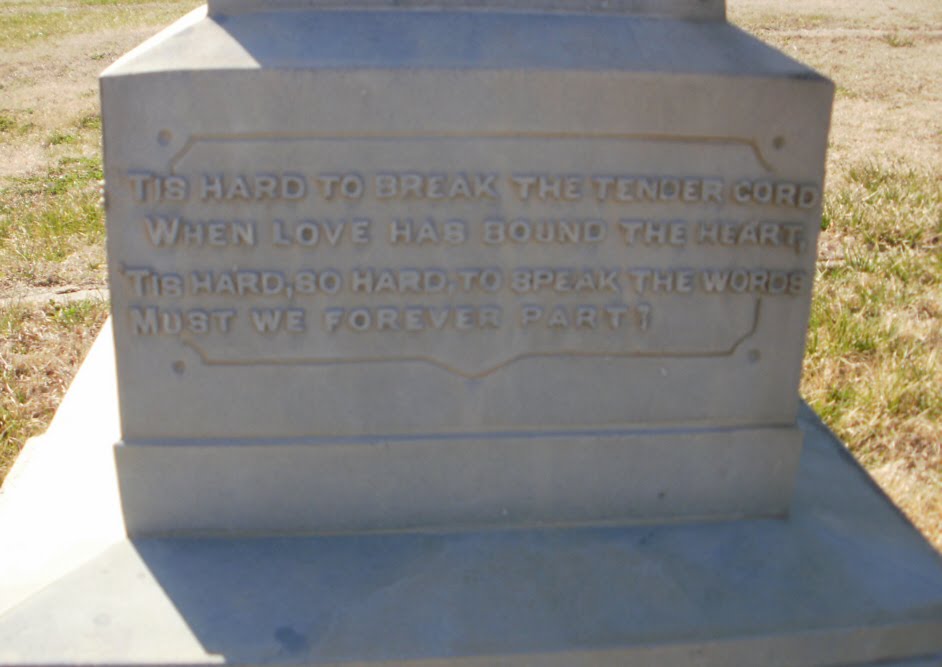
Henry and Rosa Ise's headstone is very noticeable. Rosa lived 47 years longer than her husband before her passing in Lawrence, Kansas in 1947.

Something that I learned on this Walk - in the Downs Cemetery lies the final resting place for Charles & Mayme Riggins, paternal grandparents of University of Kansas legend & NFL Hall of Famer John Riggins.

In the eastern end of the Downs Cemetery was the final stop on our Historical Walk. The Pioneers O Pioneers Monument was paid for by the Ise children in 1969 and shipped from California. On the monument are the names of all those who settled in Sod & Stubble Country before the railroad arrived in 1879.

After the Walk it was time to retire to the Gathering Grounds coffee house in downtown Downs for a celebratory Four Berry Smoothie. Sadly this was my last such drink, as the establishment would be closing at the end of April. Also celebrating there was this rather rowdy "60" club!




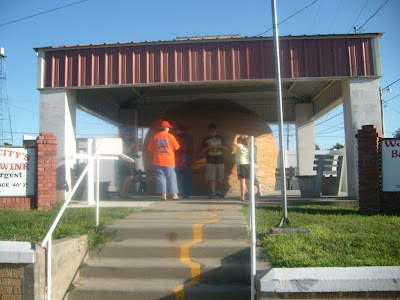


 The old adage To know where you're going, You've got to know where you've been is often more true than most people realize. It's nice to see by this plant stand that the citizens of Cawker City respect their past and their town namesale, Colonel E. Harrison Cawker. Though more respectable plants in the stand might go further to emphasize that point.


