Yes, it's true. Lucas, Kansas will soon be the location of the world's only captive wild cast iron bathtub herd. All stay tuned for further developments!!!
Sunday, June 19, 2011


Go On! Take A Day! Road Trip Kansas!
Want to cleanse your soul? Then seek a little adventure. Drive across the length of Kansas and back in a single day!
This past Friday I got the chance to do just that, and I did not even have to drive. For nearly 500 miles I could just sit back and take in the incredible vistas of everchanging color: the pastures, the hills, the valleys, the fields of golden wheat and of green corn. From Lucas to Holton and back each new view was one of simple joy in observing what there was to see.
So understand, I'm not talking about an hour or so. Really get out there - leave first thing in the morning and don't expect to be back until late that night. Just do it. And this one time, avoid the interstates and big highways - go for the little ones, the roads that abound in landscapes and sheer atmosphere as you pass through the various regions that our great Sunflower State has to offer. See people. See towns, businesses, the daily lives of fellow Kansans. Go on! Get out there!
Some suggested routes: State Highway 9. Or State Highway 4. In eastern Kansas, State Highway 57. Or State Highway 31. These are all highways that tend to really meander and have a feel of their own.
No doubt other people have some favorite routes. Send them in and I'll post them to encourage all to get out there, if just for that one day.
Saturday, June 18, 2011
The Lost Art of Wrangling and Corralling Wild Cast Iron Bathtubs
When Marci Penner, director of the Kansas Sampler Foundation, became aware that there was a need in Jackson County, Kansas for someone still versed in the lost Art of Wild Cast Iron Tub Wrangling & Corralling, the city of Lucas, Kansas was the obvious choice in which to search. One of the great centers of Art in the entire country, Lucas is the home of the Wild Tub Wranglers [Richard Mettlen, Tarry Dougherty, Connie Dougherty, and Von Rothenberger], last of a now rare breed of amusingly described rugged individualists willing to practice this now lost Art and drive nearly 500 miles in one day on just Cracker Jacks and a little ice cream.
So early on the morning of Friday, June 17, 2011, the expedition came together, a trailer was hitched, and it was off to the wilds of Northeast Kansas.

State Highway 18 and then north to State Highway 9 and east was the route of choice. Passing through Blue Rapids, Kansas, the Wranglers noted this unique take on RV camping.


The mural on the Whiting Cafe, in Whiting, Kansas enticed the Wranglers inside for a satisfying lunch of the fish special, cheeseburgers and cherry pie!


The inside of the Whiting Cafe is still clean and inviting three years after the Kansas Sampler Foundation-sponsored makeover of the business.

Driving on into Holton, Kansas, the Wranglers spied this sign. Naturally at first they thought that it was about them, but no, it was a normal circus . . . .

. . . and several unique animals were out enjoying the fine Kansas weather, including this unusual animal. Informed sources later told us that this critter is called a “Zedonk.” A cross between a zebra and a donkey was actually one of the guesses at the time, but unless you're talking wild cast iron bathtubs the Wranglers’ knowledge of exotic wildlife gets a bit spotty.


AHA! There, lying low at the far end of a grassy meadow, the Wranglers almost missed the rare sight of a herd of some fifteen wild bathtubs lying contentedly atop each other. The seasoned crew crept up silently alongside, backing up the trailer into position . . . .

Wrangling bathtubs is no easy task. One must calculate many things: the direction and location one will place a captured tub on one’s trailer; the weight of such a foul beast when filled with noxious water; the environmental impact directed upon oneself by ants, wasps, and other dangers all too often encountered. This is not an Art for the fainthearted!

Danger is ever present. Here Novice Wranger #3 slips and falls, correctly rolling out of the way while Veteran Wrangler #2 willingly sacrifices his life by placing himself between his fallen fellow and the infuriated tub.

A concerted effort pulls the protesting tub onto the trailer. An expert tub wrangler must be able to discern which tub is least likely to upset the rest of the herd should it suddenly find itself being pulled onto a trailer.

Once on the trailer the tub is turned on its side to expel the noxious water collected by such beasts after years in the wild.

Working as a team the Wranglers wrangle the tub into position on the trailer. Note how Seasoned Wrangler #1 directs the operation from the head of the tub - a sign of experience in such matters.

And so the operation continues over and over until the desired number of tubs is procured. Our apologies for the sudden blueness found in these photos. "Often in the wild, locations are primitive, and in the course of filming high-tech equipment tends to malfunction due to the humidity and other factors." At least that is The Standard Wildlife Documentary Excuse used in all such documentaries and we are sticking to it.

One difficulty with these tubs is that over the years they have a tendency to throw off their claw feet, which had to be found and collected for later reattachment.

Most tubs are pacified, domesticated eternal friends of Man. Kansas Man.


The sound that an infuriated cast iron bathtub makes is often described as being like metallic fingers scratching along a chalk board – only louder and more hollow-sounding. Fortunately the sound is several decibels above the hearing of a human and thus can be heard only by ants and wasps and, of course, the Narwhale.

The locally-mandated seasonal limit of seven tubs having been wrangled, it was time to corral the cast iron brutes for the long journey to their new homes. These tubs are destined for new lives as Much Stared Upon Wildly Painted Art Objects in and around Lucas , Kansas

Great care is taken not to harm the fiercely struggling beasts during the ritual "For Heavens Sake Would You Hurry Up And Tighten That Strap Before They Get Away" phase of the corralling. Again, these are Seasoned and Veteran Wranglers - do no try this at home.
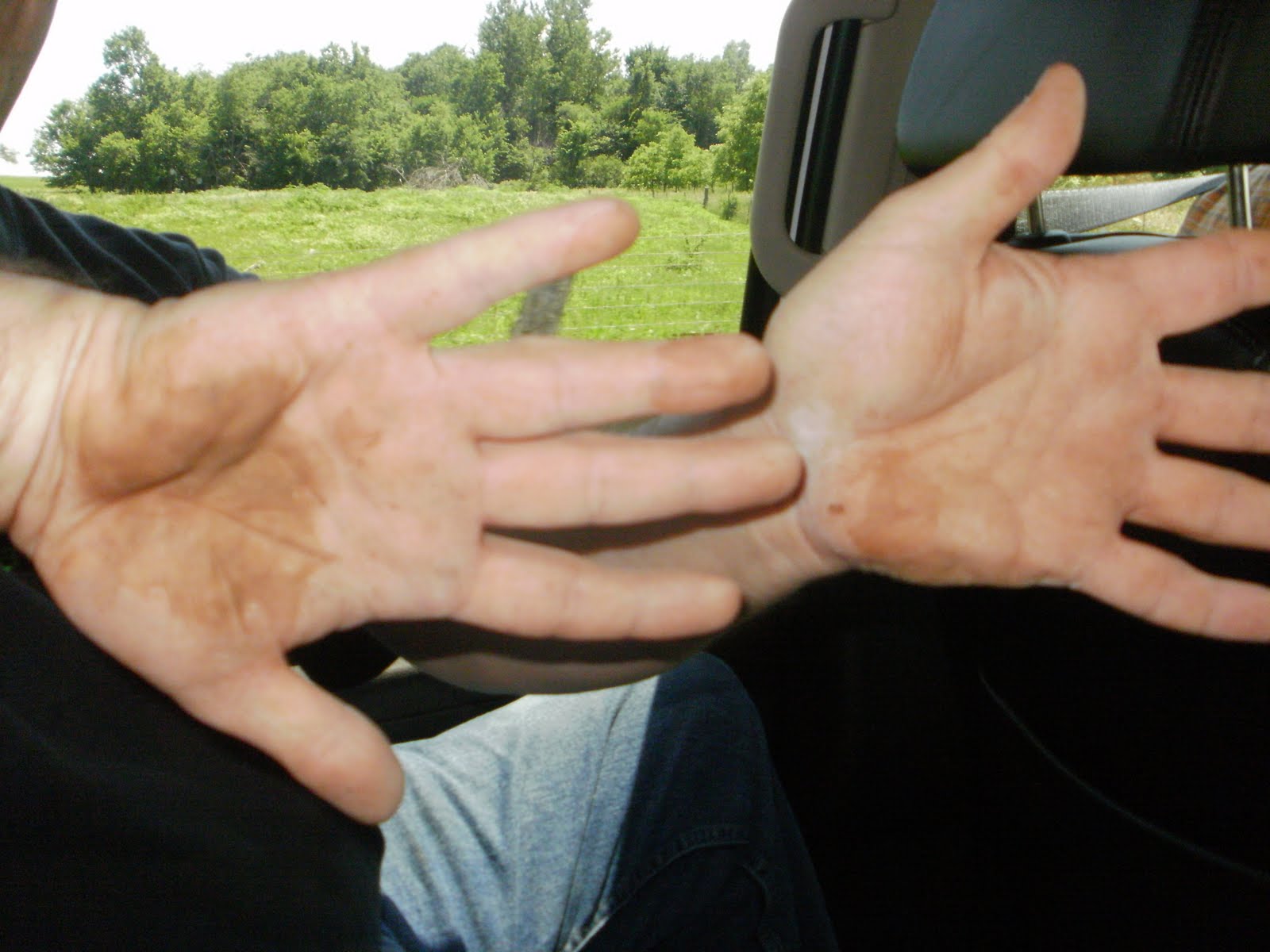
The tubs at last wrangled and corralled, the evidence of wear and tear on the tired bodies of the Wild Tub Wranglers is documented and photographed for posterity. Fortunately a Dairy Queen was discovered in nearby Holton where the Wranglers were able to clean up and be made presentable in time for obtaining rehydrating ice cream.

Tradition holds that the Novice Wrangler must carry the time honored food of the Wild Tub Wrangler Wrapup Celebration Party to the celebration's secret location in Lucas. Thus ends another thrilling adventure in the wilds of Rural Kansas!
Monday, May 30, 2011
Memorial Day 2011 Through Two Photos
There are many stories as to the actual beginnings of Memorial Day, with over two dozen cities and towns laying claim to being the birthplace of the idea. There is also evidence that organized women's groups in the South were decorating graves before the end of the Civil War.
Memorial Day is not about division. It is about reconciliation; it is about coming together to honor those who gave their all. The first Memorial Day was officially proclaimed on May 5, 1868 by General John Logan, national commander of the Grand Army of the Republic, in his General Order No. 11. It was first observed on May 30, 1868, when flowers were placed on the graves of Union and Confederate soldiers at Arlington National Cemetery.
The first state to officially recognize the holiday was New York in 1873. By 1890 it was recognized by all of the northern states. The South refused to acknowledge the day, honoring their dead on separate days until after World War I (when the holiday changed from honoring just those who died fighting in the Civil War to honoring Americans who died fighting in any war). It is now celebrated in almost every State on the last Monday in May (passed by Congress with the National Holiday Act of 1971 (P.L. 90 - 363) to ensure a three day weekend for Federal holidays).
Presently hundreds, if not thousands, of Memorial Day services are held across the United States. The rural Vincent Cemetery is located seven miles northwest of Luray, Kansas, and has held a Memorial Day service on the Sunday morning preceding the holiday for several years. Heavy fog punctuated this year's service, which was led by local resident and U.S. Navy veteran Warren Fallis. His brief remarks came from the heart and were warmly received. The service concluded as the eternal 24 notes of "Taps" rang out over the 260 graves in the small cemetery.

U.S. Navy veteran Warren Fallis collects his thoughts beneath the U.S. flag in the Vincent Cemetery.
Over the decades Memorial Day has also come to mean a time to remember all the dead buried in the nation's cemeteries. It is traditional to take the time and decorate graves with flowers and at least this one time each year to take a moment and remember past lives. In the Vincent Cemetery alone lie over 85 relatives and friends of my family on both my mother and father's lines, and by the time my sister and I had finished decorating the graves there our shoes were well soaked from all the moisture. Of course it perhaps took us a little longer than it otherwise would, as we also decorated a number of graves we have "adopted" over the years just to ensure that they are not forgotten as well.
The afternoon found us in Osborne, Kansas, to decorate graves there in the city cemetery. By now the fog had burned away and bright sunshine was everywhere. Peonie bushes, a perennial favorite for a living memorial to the dead, were in spectacular bloom this year. Many of these bushes are now several decades old. Here as well it took over an hour to adorn and thus remember those gone as several other families all around us were doing the same.
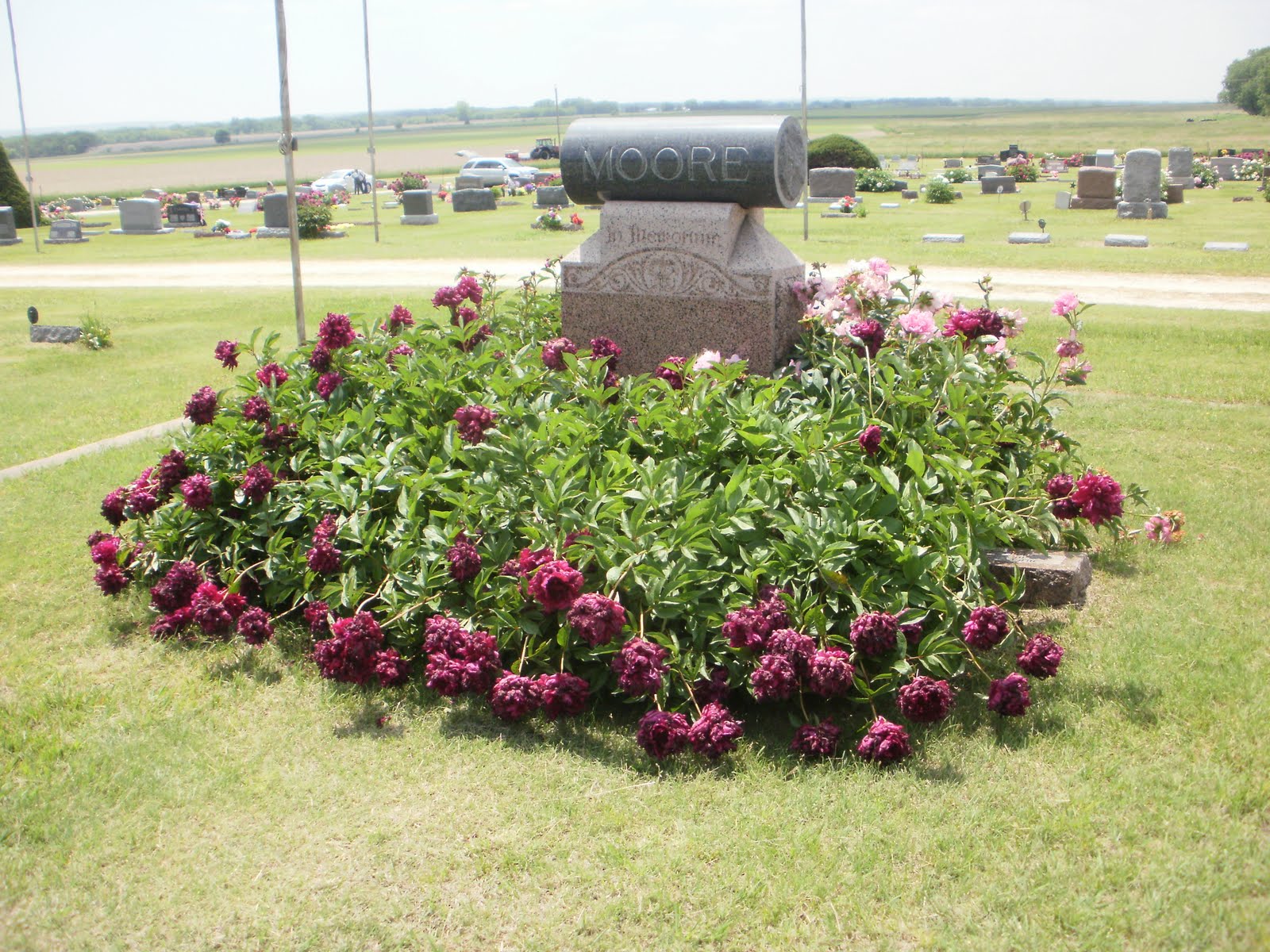
These peonie bushes on the Moore lot in the Osborne City Cemetery are nearly one hundred years old.
While on one hand it may be a shame that these remembrances occur only one time each year, perhaps it is best to consider that this time of year happens at all. So we pause to remember the well over 2,000 veterans as well as the over 14,000 marked graves buried in Osborne County, Kansas this Memorial Day.
Wednesday, May 4, 2011
For Mother's Day, 2011

My mother Delana (Pearce) Rothenberger's birthday was May 11th, which meant that every few years Mother's Day and her birthday would occur on the same day, making for a special celebration. She has now been gone ten years; this year would have been her 91st.
Sunday, April 10, 2011
Sunday Jaunt - April 10, 2011, Somewhere Between Luray & Lucas Kansas
Oncoming eye strain made it clear that it was time to get away from the computer. Temperatures in the mid-70s made it clear that it was time to drive somewhere. Thus it started out being a jaunt to discover just where the Fairview Cemetery was located southwest of Lucas. Then it became a jaunt to see if I could find the former site of the Pospect Church halfway between Luray and Lucas. Then there was this native rock barn, and then this native rock farmstead, and in an hour's time I had these photos:

Gravesite marked with stone posts & chain, Fairview Cemetery.


Grave of James E. Hall, Fairview Cemetery.


Classic Post Rock Limestone square barn.

Classic Post Rock Limestone farmstead.

Classic Post Rock Limestone fencepost.

The stone posts go on and on and on and . . . .
(This one is for my California cousin, Tim Ruth, who like most people was fascinated with the stone fenceposts!)
Monday, March 14, 2011
Guest Writer Louis Copt with "Arts Should be Funded, not Cut, during Economic Crises"
In Lucas, Kansas, it has been impossible in recent weeks not to have an opinion on Kansas Governor Sam Brownback's Executive Order eliminating the Kansas Arts Commission. In just two days, on March 16th, the Kansas Senate is set to vote on whether or not to let the Order stand. A vote of no would negate the Order; a vote of yes would allow it to occur.
In a response to the controversy surrounding this subject the following article by Louis Copt in the Kansas State Collegian does a magnificent job of articulating why the Senate should vote to reverse the Order. I repeat the article here in its entirety so that everyone can read for themselves the eloquence and surety of Copt's words; words that every Kansan - and indeed every American - should take to heart.
And on a personal note to Mr. Copt: as Jean-Luc Picard would say, "Nicely done."
Arts Should be Funded, not Cut, during Economic Crises
By Louis Copt
Published: Friday, March 11, 2011
Kansas State Collegian
From the vast plains of Western Kansas, to the tree covered hills near the Missouri border, the state of the arts in our beloved state is in jeopardy. No doubt we are in difficult times, with a sagging economy, spirit sapping unemployment and changing political fortunes. We look to an uncertain future.
There is no need for me to go over the litany of losses the state would suffer if the Kansas Arts Commission loses its funding. The dramatic drop in matching funds, the effect on jobs and the blow to small towns and tourism is well documented in the explosion of web-based communication from e-mail to Facebook. One only has to google the Kansas Arts Commission to find a host of information and action-based response opportunities.
Arts spending has become the obvious example when it comes to illustrating the evils of wasteful government. For conservatives, this has become a rich vein to mine, a platform to pontificate and a desperate distraction from more important issues.
Arts funding did not get us into financial trouble. There is plenty of public funding for highways and tax breaks for new businesses and subsidies to smooth out the business cycle for farmers. We will be further impoverished — not better off — if state funding for the arts comes to a halt.
It is often argued that the wasteful spending of today is passed down to our children. The same argument could be made that cutting the arts funding of today robs future generations of inspiration.
During the Depression, there were many farsighted people in government who joined with Roosevelt to create the Federal Art Project which, in 1934, created over 5,000 jobs for artists and produced over 225,000 works of art for the American people. Writers like Langston Hughes wrote poetry and plays. Others compiled histories and artists painted murals in small towns throughout Kansas including Sabetha, Eureka and Goodland, plus the Curry murals in the state capitol, all of which would not exist today without public arts funding. These works of art now stand as a reminder of a time in our country's history when dreams were not allowed to be destroyed by economic disaster.
Now is not the time to let our theaters go dark, our galleries to stand empty or for music to go silent. Now is not the time to pull paintbrushes from eager hands of school children or clog the pens of poets and writers. Now is not the time to put Kansas in the spotlight of ridicule or to move to the mode of mediocrity but rather to lead and inspire. Now, in fact, would be the time to increase arts funding in Kansas. Now would be the time for those interested in growing the state and jobs to step forward and champion the quality of life the arts can bring.
It is within the realm of possibility to have essential services and a healthy funding for the arts. This should not be an either/or situation. This should be an opportunity to have a dialogue on both sides to clear a path for rational thinking, to sweep aside stereotypes and know that we can have both bread and roses.
To me, the Governor's Arts Awards are not just a recognition of an individual in the arts, but a celebration of what it means to be a human who can lift hearts and minds through creative expression.
Let us tell the nation of our arts here in the sunflower state where I was born and raised, where I was educated and where I found my artistic voice. Let us now raise all our voices through painting, sculpture, theater, dance, music, arts education and philanthropy to say with one clear message, that arts in Kansas matter.
The link for this article is:
http://www.kstatecollegian.com/opinion/arts-should-be-funded-not-cut-during-economic-crises-1.2511370.
Subscribe to:
Posts (Atom)
