Saturday, December 18, 2010

October 30, 2010: First Full Day in the New Home

There was ice cream in the freezer.

On it was a note that read "Welcome to Lucas!"

Hmmm . . . I think I made the right move!

But it was not easy by a long shot - physically or mentally.  Osborne to Lucas, Kansas is only 32 miles, but when you drive it 20 times and more just moving things, it gets to be pretty long!  My sincere thanks to Sue Parker and Joe Hubbard, who in spite of all the boxes worked up a sweat to get me from one place to the other.
The all-important bed and dining table makes it way to their new home.

And so do the chests of drawers, file cabinets, and bookshelves as well.  The former home in Osborne is in the background.
First shots of the new home.  Here is the living room . . . .

And more of the living room . . . isn't it cosy . . . .
and here is the kitchen . . . .

Another view of the kitchen . . . .
We would show you the office, but I'm afraid that at the moment this is all the farther one can get in to it!

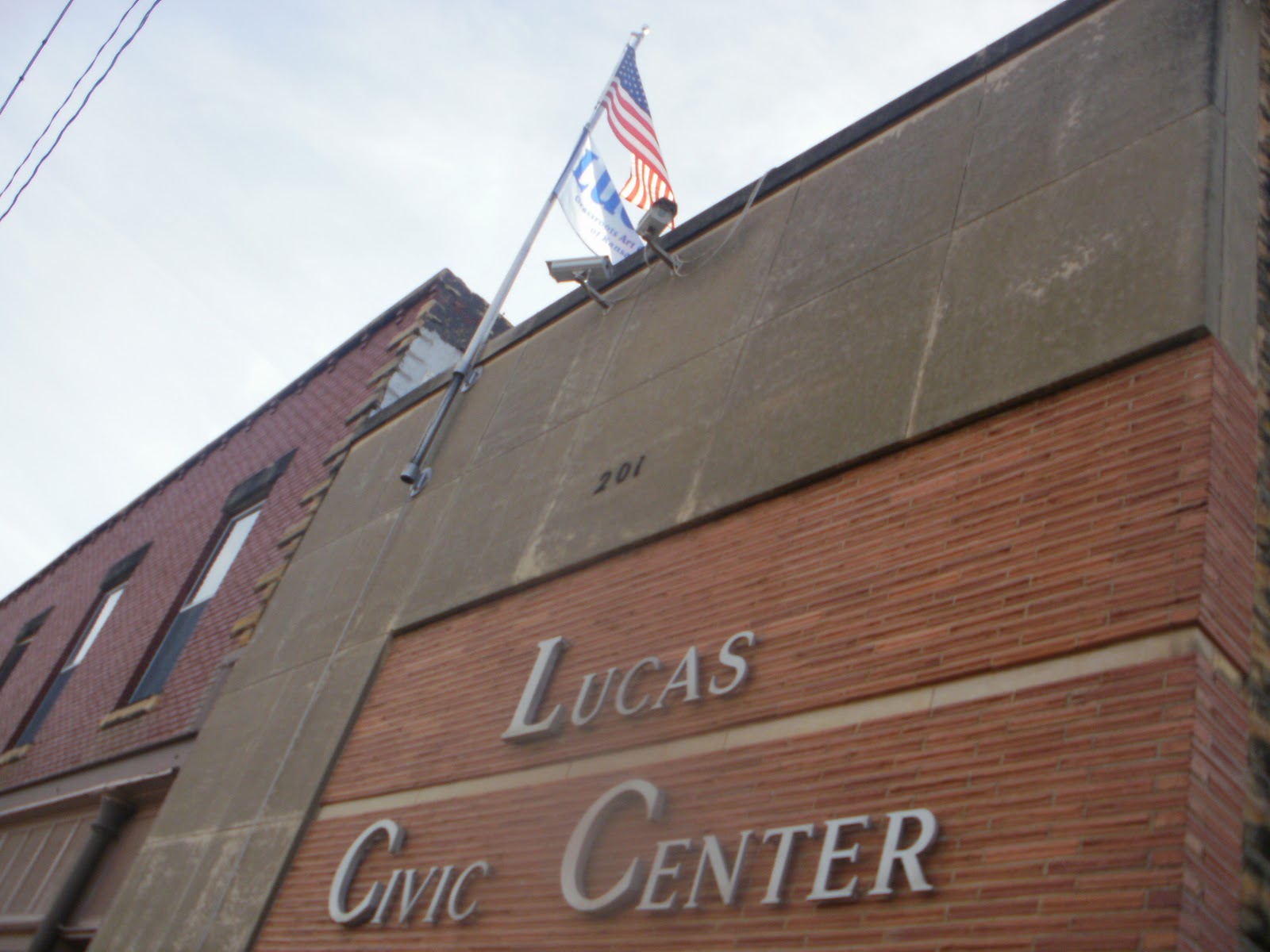
And so welcome to Lucas, population just over 400 to just over 600, depending on what source you use . . .  .

Lucas is the home to interesting things and interesting people, like the director of The World's Largest Collection of the World's Smallest Versions of the World's Largest Things, Inc.  Here is director Erika Nelson in the company car.

There is natural art in the backyards . . . .

And even man-made art in the alleys.
The downtown has places to visit . . . .

And elsewhere in town there are natural artificial critters to watch out for!
Even the area harvest becomes art in Lucas . . . .

The town has a bit of everything, including the local hair salon.

Here even abandoned Ar Deco-era gas stations become private homes, and yet look like gas stations . . . .

Throughout Lucas' history they have had far-seeing citizens . . . .

While in the present day the local lumberyard keeps busy!

Turns out the Methodist Church on North Main was bricked by the Rothenberger Masonry Company of Osborne, Kansas (my uncle and my father) . . . .

And Lucas is the home to the legendary Brant's Market, one of the 8 Wonders of Kansas Commerce and as original as they can get these days!

In Lucas the old and the new are side by side (Moran won the November 2010 election for U.S. Senator from Kansas) . . . .

And where else can you still find a public pay phone in a town this size?

In Lucas they come up with unique ways in which to celebrate the various holidays . . . .


And the Baptist Church in town is both architectually interesting and welcoming!

For Halloween all the kids in the community are treated to a hayrack ride to houses all over town . . . .

And while they no longer use the old city jail, they keep it around for show.

Local artist Eric Abraham points to a picture of himself inside his Flying Pig Art Gallery . . . . 

While also downtown the hardware store welcomes customers sone and all.

Oh, yes, there's that major folk art attraction also in the town . . . .

Whose downtown does get busy whenever there is an event - and there are a lot of events!!!

Even the local bank has a bit of flair in its name . . . .

While the local Troy's Grocery Store might sound plain, but it has pretty much everything.

This fall they started a marvelous mural on the side of the grocery store . . . .

Which when completed in 2011 (winter has asserted itself) will tell of the history of the region.

Witches have a tough time of it in Lucas . . . .

Where the flag flies proud!

Along the streets is the unusual artwork Lucas is known for . . . .

But in this community one must also look in the alleys!

Nature gets into the act here in regards to creating art . . . .

And if one looks up one can discover still more classic old man-made art!

The Grassroots Art Wall of Fame can be found here . . . .

Right next to the soon-to-be-finished Bowl Plaza - the public restrooms that will have to be seen to be believed!

There is unintentional artwork to be found . . . .

In addition to even more irrevelant man-made art!

Only in Lucas can be found a sign reminding you of what town you are in . . . .

As if you need yet another reminder, amidst the middle of an American Fork Art garden!

In Lucas the downtown is Wi-Fi'ed and has a very discernable line down Main Street . . . .

And local pride can be found in the fabulous all-volunteer Theater!

Downtown Lucas is made safe for your protection . . . .

And the city office shows its pride with pride!

There is a Lucas Public Library . . . . 

And older buildings downtown sport even more architectural wonders!

Ah, yes, the Grassroots Arts Center is here in Lucas . . . .

And they are ready for Halloween!

Lucas does have some very interesting signage . . . .

And some classic stone carvings as well!

A throughly modern volunteer fire department can be found here . . . .

And again in the back alleys can be found more interesting gardens and fences.

In Lucas you can find wire Bald Eagles . . . .

And classic churches . . . .

Not to mention the random land serpent.

Yes, Lucas is the birthplace of K-18 Baseball, which gave hundreds of kids over many decades great fun . . . .

And one of the first things one notices about the town is that it is a green-topped water tower town.

There is great tinwork to be found, if you once again look up once in a while . . . .

And did we mention the unusual signage?

And now that we've roamed our new Home, we really do need to get back to that ice cream!  Thank you, Lucas!!!

IN SEARCH OF: May 26, 2010 - Charlie Brenscom & The Great Indian Scare of 1878

THE SCENE:  For over a year I had been crisscrossing Osborne County, taking photographs of every tombstone known standing in the county. Now I was down to trying to locate those solitary stones rumored to be scattered here and there across farmers’ fields and ranchers’ pastures. Today’s hunt would be for the gravestone of Charlie Brenscom.

THE BACKGROUND:  Charlie Brenscom was an invalid living in Mount Ayr Township of western Osborne County when one of the more notorious incidents in Osborne County history occurred. What afterwards became known as the two days of “The Great Indian Scare of 1878” had its origins in late September of that year, when a band of Cheyenne Indians left their reservation in Indian Territory (today’s Oklahoma) to seek their old homelands in the Dakotas. They headed north through Kansas between Forts Wallace and Hays, throwing the western half of the state into a panic as one can imagine. The commandant of Fort Hays was unsure of the Indians’ intentions and as a precaution sent riders galloping east down the Saline and Smoky Hill river valleys to warn everyone of the potential danger.

Word reached Osborne County on October 7th via freight wagon drivers from Russell, Kansas, who by the time they arrived in the southern half of the county managed to change the message from “potential danger” to “they are coming!”

Now all of Osborne County was thrown into a panic. Stories abound both comic and tragic of the settler’s reactions over the next two days.  Former Civil War soldiers now homesteading the region took up their guns, organized under old officers, and took to roving the countryside searching for incoming war bands of Indians.  The dust rising from these roving soldier bands in the Paradise Creek region of southwestern Osborne County  was mistaken by other roving bands as being “the Indians – they are here!” and soon hundreds of people were tossing their belongings onto horses and into wagons and fleeing to the north and east. At Covert, halfway across the county, a funeral was being held when the news came. The mourners immediately fled northeast to the county seat of Osborne, leaving the unfortunate Mrs. Morris in her coffin still resting on two sawhorses, the pages of the Bible atop the coffin flapping in the breeze.

The domino effect continued. At Vincent in southern Osborne County a little girl mistook just cut stalks in a cornfield for Indian teepees and raced to town to warn everyone. Most of the community formed a small wagon train and fled northeast through the Blue Hills to the next small community of Potterville. Several men volunteered to stay behind and so give their loved ones a chance to get away. They raided the local general store for guns and gathered in Ira Pitzer’s stone house to make a last stand against the oncoming Indians. Only then did they realize that they had neglected to bring any ammunition along.

When the Vincent refugees reached Potterville that community was promptly abandoned at the news, the all-important post office was packed in a trunk, and still more wagons and people joined the growing train that now made its way fifteen miles northeast through the hills to the comparative safety of the town of Tipton in Mitchell County.

The Scare was in full swing by the time the news reached Osborne in the north central part of the county.  Five hundred settlers overturned wagons, barrels, and anything else they could find to build a barrier, quickly dubbed “Fort Osborne,” behind which they settled all that day and through the next night, waiting in vain for Indian warriors that never came.

The next day, October 8th, the word reaching far eastern Osborne County from fleeing refugees warned that “the entire Indian nation in the West was uprising” and that “three million Indians” were bearing down on the poor settlers, causing still more panic. But by October 9th things began to die down as people started realizing that no real Indians had actually ever appeared.  Sheepishly they began to return to their homes.  But not all.  The estimate is that approximately ten thousand people fled from Osborne County alone over those two days, and of that number nearly four thousand never came back. They had had enough of the "Wild" West.

In his 1882 “Osborne County Annals of the Year 1878” Osborne lawyer Zachary T. Walrond had this to say about the Scare: “October 8th: There is a great scare in the western part of Osborne County, the alarm originating from a rumor that the wild Indians are raiding down Paradise and Eagle Creeks; five hundred settlers go to the defense of Osborne. Chas. Branscomb [sic], an invalid, dies while his friends are removing him to a place of safety.”

Which brings us back to Charlie Brenscom.

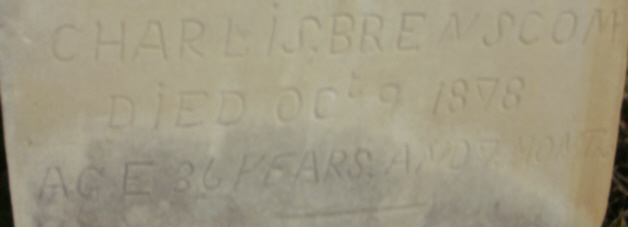
THE SEARCH:  What I had to go on to find Charlie Brenscom's gravestone came from two sources.  The first was Mrs. Auldin Conrad, who lives across the road from the Fairwest School, District #38, a long-abandoned frame one-room rural schoolhouse still standing in the northeast quarter of Section 25 in southeastern Mount Ayr Township.  Now well into her 80s, Mrs. Conrad had just a few years ago had told me that the stone was still to be found "just behind the schoolhouse" and then told me the wonderfully absurd story passed down in the area that periodically Indians used to stop by Charlie's stone, and after they left the local people would come and poke around the grave, thinking that the Indians might have buried treasure there.  My second source was the above photo, taken in 1977 of the headstone by the Osborne County Genealogical & Historical Society, showing the Fairwest schoohouse in the left background.  The closeness of the stone to the school in the photograph made seem that this stone would be easy enough to find.

So 23 years after that last photograph I and my recruited help, Merlyn Brown, owner of Osborne’s Merlyn Entertainment Group graphic arts company and an avid photographer by trade, found us driving the gravel roads of Mount Ayr Township toward the Fairwest School, seen here in center background.


The night before I had tried to contact Randy Conrad, the local landowner, to let him know that we might be out and about on his land around the schoolhouse, but had no luck in reaching him.  In our confidence on knowing local customs and figuring that if we ran into Randy we could let him then know what we were doing, we proceeded with no guns or bags, only cameras, in trespassing on his land - you kids reading this at home should NEVER do this.  We were wrong and I apologize here to Mr. Conrad and to all rural landowers for our arrogance.   And yes, we paid for it.

Mrs. Conrad had said that the stone was "just behind the schoolhouse."  Well, it wasn't.  We searched and searched, getting into some pretty rough overgrowth that stood taller than what the gravestone probably was.  In the photo above the Fairwest School can just be seen to the left of the trees in the far background.

We continued to search in this overgrowth for nearly an hour in vain.  If the stone was here it might be knocked over by now, and if that happened in this growth then there was no way to find it - unless one literally stumbled over it. 

Over an hour later we were well to the south of the schoolhouse.  No gravestone.  Nothing else of worth to even photograph.  Nothing but sweat, bites, welts, and a couple of small cuts to show for our efforts. 

Taking a look at that 1977 photograph again, this time it registered that the stone might not behind the schoolhouse, but more to the south of the school.  As in the next field?  Merlyn went ahead of me, and sure enough, there was the grave.  Hey, Merlyn, look behind you!

Charlie Brenscomb's grave lies at least a quarter mile south and just a smidgen west of the schoolhouse in the middle of a corn field.  Just to the right of Merlyn's camera you can see the Fairwest School.

Considering its age (129 years), Charlie's native limestone, handcarved headstone is in remarkable shape and still quite readable.

We take one last photograph of Charlie's grave, secure in the knowledge that it was still to be found in the year 2010. 

Flush with success, we head south to Natoma in southwestern Osborne County and stop at the cemetery there.  Why?  Why, so Merlyn can take photos of horses, of course!

Actually, there was one more tombstone that I needed a good photograph of in the Natoma Cemetery.  For this region the stone on Ken and Leah Griffin's grave is a bit unusual!

We then turn east from Natoma down Kansas State Highway 18 under a beautiful sky.  We are approaching the town of Paradise, Kansas.

In approaching Paradise one cannot help to see the iconic 1888 Post Rock Limestone city watertower.

Now, if one kept going on down Kansas State Highway 18 one will eventually come to the Garden of Eden, in Lucas, Kansas.  Russell County, Kansas - one of only two places I know in the world where one can find in close proximity Paradise and the Garden of Eden!

Needing to get back to Osborne, we take the opportunity to drive down a few Kansas backroads so that I can take Merlyn to the Cedar Bluff Cemetery in central Osborne County, as he had never been there before.

And he was immediately captivated.  What is he taking a photo of??

Ah.  I see.

Cedar Bluff Cemetery is noted for the large cedar trees that tower over the cemetery.

Here in late May older strains of the iris flower abound around 120-year old graves.

Even the summer lilac can be found here!

This is the road into the cemetery.  Some people, upon seeing it, might just be a little bit hesitant . . . . 

 . . . . especially when they see the old 1920s era bridge they have to cross!

The bridge spans Covert Creek, which is flowing nicely due to recent rains in the area.

And here the summer lilacs can really be found in full bloom!

Reluctantly the day was ending, and we would have to wait until another day to once again explore the backroads of Osborne County!

Personal Blog Moment: A Christmas Card Tradition

Una Mae's card came yesterday.


Christmas traditions are especially revered in our culture.  Everyone has certain small things that their family invariably follows year after year - special Christmas ornaments passed down that are put on the tree, foods that are always served at Christmas dinner, even the way presents are passed out.  For me the annual card from Una Mae carries on a very personal tradition.

Back in the fall of 1941 my father, Waldon Rothenberger, was serving in the U.S. Army at Westover Air Field (now Westover Joint Air Reserve Base) in Chicopee, Massacusetts, just outside of the city of Springfield.  In those uncertain days just prior to the United State's entry into World War II my mother Delana went to join him there, and on November 27th they were married in Chicopee.  Their first home together was an apartment in a private home in nearby Holyoke, Massachusetts.  There they became great friends with Una Mae Facetti, their landlord's daughter, who was of junior high age.

The next year Waldon was transferred to England and my mother came back to Kansas for the duration of the war.  In December 1942 she sent a Christmas card to Una Mae, who was very surprised.  She sent one back, and so an annual tradition of exchanging Christmas cards between the two began. 

In 1992 I got to make a trip with my mother back to Massachusetts, and Delana and Una Mae got to finally meet again face-to-face after 50 years of exchanging cards.  The two never met again but kept the card exchange going until my mother's passing in January 2001.  The following Christmas it just seemed natural for Una Mae to continue sending a card - this time to me.

Fast forward a mere 68 years later to December 2010 - well into  "The Digital Age" - and still a card made its way two weeks ago to Massachusetts, and this week a Massachusetts card made its way to back to Rural Kansas.  I wrote about my move to Lucas, Kansas and Una Mae wrote of new great-grandchildren and of snow and of the possibility of having to move as well from her home of many decades.  The news exchanged was small, but for a moment it made the distance halfway across the United States even smaller. 

Here's to one small holiday tradition hopefully continuing well into its seventh decade.

Wednesday, December 1, 2010

DO NOT PANIC!!!

"DO NOT PANIC!  PLEASE REMAIN CALM!" - from the movie Animal House (1978).


It SEEMED like a good idea at the time.

They THOUGHT it would be easy.

For those of you who are still worrying about THIS year and have not been paying attention, next year is the 150th birthday of Kansas.  For some months various state officials and agencies have been wracking their brains trying to think of ways to celebrate this important milestone - cheaply, of course.  

And on November 5, 2010, the following email was sent out across the state:

"Dear Genealogists and Historians,

In commemoration of Kansas’ 150th Birthday and in conjunction with Savor Kansas and Visit Topeka Incorporated, Kansas Network to Freedom is holding a drive to collect local Kansas history for the Kansas 150th Commemorative Calendar.

We are asking every county and/or local society to contribute important dates, pictures of important historical figures and places, and information about their local history to include in the calendar that will be available at the 150th Celebration in Topeka on January 29th, 2011.

Submissions should be sent as attachments via email. Deadline for submissions is November 20th. Selections will be chosen from submissions sent in by the due date. If you have any questions please email or call Sherri Camp. See my information below.)

To contribute, send email to:
Sherri Camp, President
Kansas Network to Freedom
785-969-9144
sherri@kansasnetworktofreedom.com

Thank you,
Sherri Camp"


Now, to the average layman 15 (fifteen) days would no doubt seem like plenty of time to compile such a list of dates, events, and photographs from every county.  They all have them just lying around already compiled, right?

Unfortunately, no.  Most counties don't have anyone who has sat and thought out such things.  Oh, they might remember such events as when the county was formed, and when the county celebrated its centenary, but that is pretty much about it.  And as to the actual dates?  And photos as well?  All that takes time to gather - say, six months, or more. 

And here you have been given 15 (fifteen) days. 

Now imagine what the Osborne County Genealogical & Historical Society thought when they read this email.  Like most of the small, local, all-volunteer-run such organizations across the state of Kansas, the OCGHS does not have someone reading the emails each and every morning.  Truth be told, they are lucky to have volunteers to even man the Society's office/archives for a few hours on any given day.  So when this particular email was read on November 18th - yes, November 18th, as in two days before the deadline for submissions - one can imagine the panic that set in.  After all, they want to be included in this celebration of the state, but - !

Years of being a state representative allowed OCGHS president Laura McClure to marginally control her personal panic enough to quickly send out emails asking for help in the matter.   

As one can imagine, the emails flew back and forth fast and furious.  No one - in Osborne County, at least - had ever sat down and compiled such a list of important events from throughout the county's history.  And we are talking about combing through the county's entire 140 years of political, social, and economic legacy in just two days to make such a list!  What events are important enough to be included?  Usually a year can be found for when events occurred, but what were the actual dates?  And where do you find these at?  And what events are important enough to be included?  And photographs, if available, would need to be found and copied.  And what events are important enough to be included?

And so it was with some relief (and great coincidence) that on that same day - November 18th - a second email was received announcing that the deadline for submissions was extended to December 1st.  Evidently the uproar had not come from Osborne County alone.  Still, that only left 12 (twelve) days in which to compile such a submission. 

So books were pulled, photographs and CDs of scanned photographs perused, the poor people at the county courthouse in charge of maintaining the county records duly harrassed, and every site on the Internet dealing with Osborne County history was consulted, and in 12 days 36 points from the county's past were brought forth.  Of these, two dates could not be confirmed in the time alloted, so they were dropped, leaving just 34 items from the county's 140 years of existence to be shared with the rest of Kansas. 

The following is the 34 entries sent in, along with the two not submitted - still great events in their own right - by the Osborne County Genealogical & Historical Society.  While the list does give some insight into this typical Rural Kansas county's legacy (as well as the mindset of those who compiled the list) please keep in mind that this list merely scratches the surface of this county's rich history, and in no way should be considered the final product:


           Important Historical Dates - Osborne County, Kansas:

July 21, 1866 – Irish-born U.S. Army soldier Edward Roche of Company I, 2nd U.S. Cavalry, is killed by Indians along Twin Creek while escorting the party surveying what will later become Osborne County. They bury Roche at what later becomes the common corner of Corinth, Penn, Winfield and Bloom Townships; he is later moved to the Osborne City Cemetery.

March 3, 1867 – Kansas Governor Samuel B. Crawford officially names Osborne County in honor of Captain Vincent B. Osborne, a Civil War veteran who lost a leg in a battle on January 17, 1865.

January 14, 1870 - The first homestead in Osborne County is settled on by George Wolberd in the northeast corner of the county, in Section One of what later becomes Ross Township.

March 4, 1870 – Charles and William Bullock settle on claims in what later becomes Tilden Township, where they erect Bullock’s Stockade, the first permanent settlement in Osborne County.

July 2, 1870 – The Last Indian Raid in Osborne County takes place by a band of approximately 50 Indians at Bullock’s Stockade. Two Indians are killed in the brief skirmish.

August 10, 1870 – Around this time Dr. Daniel Tilden arrives in Osborne County to claim a homestead in what later becomes Tilden Township. In the spring of 1871 he lays out and plats the townsite of Tilden on his homestead. In 1874 the town’s name is changed to Bloomington.

September 12, 1870 – Founding of the town of Bull City by Hiram C. Bull and Lyman T. Earl. A coin toss determines the name of the town. In 1885 the town’s name is changed to Alton.

November 8, 1870 – Founding of the town of Arlington by Calvin Reasoner and others and opening of the Reasoner-Thompson General Store.

May 1, 1871 – Founding of the town of Osborne City by the Pennsylvania Colony. By the early 1890s the “City” is dropped from the name.

June 2, 1871 – Founding of the town of Bethany, named by Zachary T. Walrond, and opening day for the Bethany Post Office. In 1880 the town’s name is changed to Portis.

June 3, 1871 – Meeting for the formal organization of Osborne County is held at Arlington on the steps of the Reasoner-Thompson General Store.

October 29, 1871 – J. B. Emley begins touting his new town of Emley City, at the center of Osborne County in what later becomes Independence Township, as the perfect site for the permanent county seat. In 1873 the town’s name is changed to Centerville. In 1876 it is changed again, this time to Bristow.

April 2, 1872 – Fourth and final election for permanent Osborne County Seat. Osborne City receives 267 votes to Arlington’s 214.

June 19, 1873 – Arrival of Henry and Rosa Ise at Henry’s homestead in Ross Township of Osborne County. The story of their life on this homestead, Sod & Stubble, written by their son John Ise, was first published in 1936.  Still in print 75 years later, the book is considered a classic on the homesteading era of the Great Plains of North America.

March 22, 1877 – Arrival of Howard Ruede on his homestead in Kill Creek Township of Osborne County. The story of his life on this homestead, Sod-House Days: Letters of a Kansas Homesteader 1877-78, was first published in 1937. Still in print nearly 75 years later, the book is considered a classic on the homesteading era of the Great Plains of North America.

June 5, 1879 – The townsite of Downsville is platted by landowners John Bea1, Azariah & Marinda Blunt, Mrs. Harriet DeLay, with Missouri Pacific Railroad president R. M Pomeroy in Sections 28 and 29 of Ross Township. Within six months the town’s name is shortened to Downs.

October 12, 1879 – Osborne County State Representative Hiram C. Bull and two other men are attacked and killed at Bull City by Bull’s pet elk. The sensational event makes national headlines and the subsequent funeral draws approximately 2,000 people. It is still considered the largest funeral ever held in northwest Kansas.

October 19, 1880 – The townsite of Covert is surveyed and laid out in central Osborne County, with a plat of the town being duly recorded on October 26, 1880.

May 1, 1887 – What is considered to be the first self-driving vehicle ever built in Kansas is invented by Osborne City blacksmith Frank Hatch. The vehicle consists of a wagon propelled by a four-cylinder vapor engine. It is driven that spring and summer through the streets of Osborne City and the surrounding countryside before being dismantled.

October 15, 1888 – The Union Town Company surveys and lays out a plat for the new town of Natoma in the southwest corner of Osborne County.

November 1, 1901 – Around this time is the establishment of Meades Ranch in Delhi Township, Osborne County as the Geodetic Center of North America. This unique and important scientific site is the reference point for all property lines and city, county, state and international boundaries on the North American continent that are tied to the national triangulation networks of the United States, Canada, Mexico, and Central America. It was renamed the North American Datum in 1927.

May 29, 1904 – Birth in Downs, Kansas of psychiatrist Dr. Robert Hanna Felix, creator of the National Institutes of Mental Health.

June 8, 1904 – Birth in Alton, Kansas of internationally-acclaimed architect Bruce Alonzo Goff.

January 25, 1907 – John Locke, 1976 National Basketball Coach of the Year and the winningest high school basketball coach in Kansas history, is born on the family farm in Kill Creek Township of Osborne County.

October 7, 1912 – The original landowners relinquish all rights to a 40-acre tract around the Seventh-day Adventist-operated Hill Agricultural Academy in eastern Bethany Township. The land is laid out and platted as the townsite of Academy.

April 26, 1929 – Osborne High School junior Fred Stambach Jr. makes a high jump of six feet, 3.5 inches at the county track meet in Downs. With this one jump Stambach breaks six records – the school, county, district, state, national, and world’s interscholastic records. Though his world record is beaten just 24 hours later, Stambach’s jump stands as the Osborne High School record for the next 70 years.

September 22, 1943 – Crash of a B-24 bomber from California to Topeka, Kansas in southern Covert Township of Osborne County, killing eleven military servicemen aboard.  In April 2004 a memorial was dedicated at the site to their memory.

October 19, 1968 – Agra High School’s football team defeats Alton High School 19-13, ending Alton’s six-year, 51-game winning streak. The streak was the all-time state record for most consecutive football victories for nearly 35 years and for three decades was among the Top Ten such streaks nationally as well.

May 22, 1970 – Last day of classes for Oakdale School, District #3, in Ross Township. This was the last one-room rural schoolhouse in Osborne County.

October 14, 2000 – Osborne High School senior Brittany Dietz wins her fourth straight Class 3-2-1A girls’ tennis championship. She finishes her high school career with the all-time state high school single-season record of 43 wins (1997) and the greatest all-time career record of 149 wins and no losses.

March 27, 2003 – Osborne High School senior Brooke Ubelaker is named Miss Kansas Basketball. In four years she led the Bulldogs to a 99-5 record, two state championships, and two state runner-up finishes.

November 27, 2003 - Acknowledging Osborne County as the home of two famous books on the homesteading era of the Great Plains of North America, the Osborne County Commissioners adopt a proclamation designating Osborne County, Kansas as "The Homestead Literature Capital of Kansas."

April 2, 2007 - The Kansas Senate passes Senate Resolution No. 1859, declaring that the "Sod & Stubble Country Self-Guided Tour" in Bethany and Ross Townships of Osborne County to be an official state heritage tour.

April 25, 2008 – The century-old Osborne County Courthouse is named one of the 24 finalists for the 8 Wonders of Kansas Architecture contest. The building is selected as being the best example of James Holland-designed courthouses in the state.

 
[And here are the two deleted entries, again only because the exact dates were not able to be found in the time allotted:]

1880 – While digging a well in Section 27 of Hawkeye Township a man uncovers what he believes to be gold nuggets. Word quickly spreads to the nearby community of Bloomington, and the great Bloomington Gold Rush of Osborne County is on. Hundreds of area farmers immediately converge and illegally begin digging in and around the homestead where the strike occurred. The next day two experienced miners now farming in the area examine the original rocks and determine that they are indeed pieces of pyrite, or “fools gold,” effectively ending the rush.

1904 – Bert Walker buys the Osborne County Farmer newspaper in Osborne. Together with Farmer editor and Kansas Speaker of the House of Representatives Charles Mann, the newspaper over the next 44 years becomes for a time the most influential weekly small town newspaper in Kansas.

*  *  *  *  *

To sum it all up:  if anyone out there of any influence or position has been reading this, please in the future take the time to truly consider what you are asking and to properly think it all through first.  You are driving the volunteers - that are driving this state in the first place - absolutely nuts!