Monday, May 30, 2011

Memorial Day 2011 Through Two Photos

     There are many stories as to the actual beginnings of Memorial Day, with over two dozen cities and towns laying claim to being the birthplace of the idea.  There is also evidence that organized women's groups in the South were decorating graves before the end of the Civil War. 
     Memorial Day is not about division. It is about reconciliation; it is about coming together to honor those who gave their all.  The first Memorial Day was officially proclaimed on May 5, 1868 by General John Logan, national commander of the Grand Army of the Republic, in his General Order No. 11.  It was first observed on May 30, 1868, when flowers were placed on the graves of Union and Confederate soldiers at Arlington National Cemetery. 
     The first state to officially recognize the holiday was New York in 1873. By 1890 it was recognized by all of the northern states.  The South refused to acknowledge the day, honoring their dead on separate days until after World War I (when the holiday changed from honoring just those who died fighting in the Civil War to honoring Americans who died fighting in any war).  It is now celebrated in almost every State on the last Monday in May (passed by Congress with the National Holiday Act of 1971 (P.L. 90 - 363) to ensure a three day weekend for Federal holidays).

    
     Presently hundreds, if not thousands, of Memorial Day services are held across the United States.  The rural Vincent Cemetery is located seven miles northwest of Luray, Kansas, and has held a Memorial Day service on the Sunday morning preceding the holiday for several years.  Heavy fog punctuated this year's service, which was led by local resident and U.S. Navy veteran Warren Fallis.  His brief remarks came from the heart and were warmly received.  The service concluded as the eternal 24 notes of "Taps" rang out over the 260 graves in the small cemetery.

 U.S. Navy veteran Warren Fallis collects his thoughts beneath the U.S. flag in the Vincent Cemetery.

     Over the decades Memorial Day has also come to mean a time to remember all the dead buried in the nation's cemeteries.  It is traditional to take the time and decorate graves with flowers and at least this one time each year to take a moment and remember past lives.  In the Vincent Cemetery alone lie over 85 relatives and friends of my family on both my mother and father's lines, and by the time my sister and I had finished decorating the graves there our shoes were well soaked from all the moisture.  Of course it perhaps took us a little longer than it otherwise would, as we also decorated a number of graves we have "adopted" over the years just to ensure that they are not forgotten as well. 

     The afternoon found us in Osborne, Kansas, to decorate graves there in the city cemetery.  By now the fog had burned away and bright sunshine was everywhere.  Peonie bushes, a perennial favorite for a living memorial to the dead, were in spectacular bloom this year.  Many of these bushes are now several decades old.   Here as well it took over an hour to adorn and thus remember those gone as several other families all around us were doing the same. 
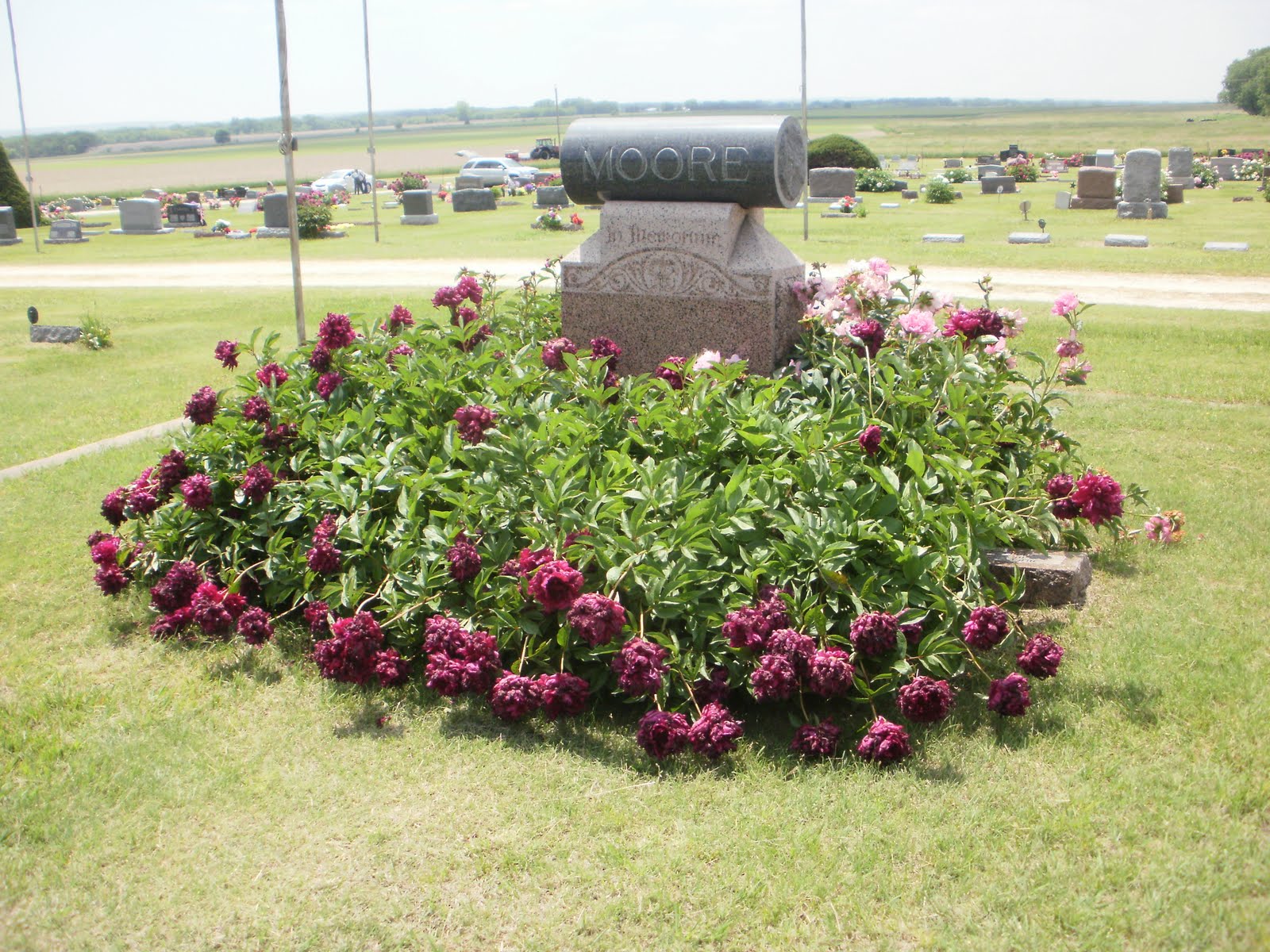

These peonie bushes on the Moore lot in the Osborne City Cemetery are nearly one hundred years old.

     While on one hand it may be a shame that these remembrances occur only one time each year, perhaps it is best to consider that this time of year happens at all.  So we pause to remember the well over 2,000 veterans as well as the over 14,000 marked graves buried in Osborne County, Kansas this Memorial Day.

Wednesday, May 4, 2011

For Mother's Day, 2011

My mother Delana (Pearce) Rothenberger's birthday was May 11th, which meant that every few years Mother's Day and her birthday would occur on the same day, making for a special celebration. She has now been gone ten years; this year would have been her 91st.

Sunday, April 10, 2011

Sunday Jaunt - April 10, 2011, Somewhere Between Luray & Lucas Kansas

Oncoming eye strain made it clear that it was time to get away from the computer.  Temperatures in the mid-70s made it clear that it was time to drive somewhere.  Thus it started out being a jaunt to discover just where the Fairview Cemetery was located southwest of Lucas.  Then it became a jaunt to see if I could find the former site of the Pospect Church halfway between Luray and Lucas.  Then there was this native rock barn, and then this native rock farmstead, and in an hour's time I had these photos:

 Gravesite marked with stone posts & chain, Fairview Cemetery.

 Grave of James E. Hall, Fairview Cemetery.

 The remains of just four grave sites are all that now can be found in the Fairview Cemetery.

 Classic Post Rock Limestone square barn.

 Classic Post Rock Limestone farmstead.

 Classic Post Rock Limestone fencepost.

The stone posts go on and on and on and . . . .
(This one is for my California cousin, Tim Ruth, who like most people was fascinated with the stone fenceposts!)

Monday, March 14, 2011

Guest Writer Louis Copt with "Arts Should be Funded, not Cut, during Economic Crises"

     In Lucas, Kansas, it has been impossible in recent weeks not to have an opinion on Kansas Governor Sam Brownback's Executive Order eliminating the Kansas Arts Commission.  In just two days, on March 16th, the Kansas Senate is set to vote on whether or not to let the Order stand.  A vote of no would negate the Order; a vote of yes would allow it to occur.
     In a response to the controversy surrounding this subject the following article by Louis Copt in the Kansas State Collegian does a magnificent job of articulating why the Senate should vote to reverse the Order.  I repeat the article here in its entirety so that everyone can read for themselves the eloquence and surety of Copt's words; words that every Kansan - and indeed every American - should take to heart. 

     And on a personal note to Mr. Copt:  as Jean-Luc Picard would say, "Nicely done."


Arts Should be Funded, not Cut, during Economic Crises


By Louis Copt
Published: Friday, March 11, 2011
Kansas State Collegian

     From the vast plains of Western Kansas, to the tree covered hills near the Missouri border, the state of the arts in our beloved state is in jeopardy. No doubt we are in difficult times, with a sagging economy, spirit sapping unemployment and changing political fortunes. We look to an uncertain future.
     There is no need for me to go over the litany of losses the state would suffer if the Kansas Arts Commission loses its funding. The dramatic drop in matching funds, the effect on jobs and the blow to small towns and tourism is well documented in the explosion of web-based communication from e-mail to Facebook. One only has to google the Kansas Arts Commission to find a host of information and action-based response opportunities.
     Arts spending has become the obvious example when it comes to illustrating the evils of wasteful government. For conservatives, this has become a rich vein to mine, a platform to pontificate and a desperate distraction from more important issues.
     Arts funding did not get us into financial trouble. There is plenty of public funding for highways and tax breaks for new businesses and subsidies to smooth out the business cycle for farmers. We will be further impoverished — not better off — if state funding for the arts comes to a halt.
     It is often argued that the wasteful spending of today is passed down to our children. The same argument could be made that cutting the arts funding of today robs future generations of inspiration.
     During the Depression, there were many farsighted people in government who joined with Roosevelt to create the Federal Art Project which, in 1934, created over 5,000 jobs for artists and produced over 225,000 works of art for the American people. Writers like Langston Hughes wrote poetry and plays. Others compiled histories and artists painted murals in small towns throughout Kansas including Sabetha, Eureka and Goodland, plus the Curry murals in the state capitol, all of which would not exist today without public arts funding. These works of art now stand as a reminder of a time in our country's history when dreams were not allowed to be destroyed by economic disaster.
     Now is not the time to let our theaters go dark, our galleries to stand empty or for music to go silent. Now is not the time to pull paintbrushes from eager hands of school children or clog the pens of poets and writers. Now is not the time to put Kansas in the spotlight of ridicule or to move to the mode of mediocrity but rather to lead and inspire. Now, in fact, would be the time to increase arts funding in Kansas. Now would be the time for those interested in growing the state and jobs to step forward and champion the quality of life the arts can bring.
     It is within the realm of possibility to have essential services and a healthy funding for the arts. This should not be an either/or situation. This should be an opportunity to have a dialogue on both sides to clear a path for rational thinking, to sweep aside stereotypes and know that we can have both bread and roses.
     To me, the Governor's Arts Awards are not just a recognition of an individual in the arts, but a celebration of what it means to be a human who can lift hearts and minds through creative expression.
     Let us tell the nation of our arts here in the sunflower state where I was born and raised, where I was educated and where I found my artistic voice. Let us now raise all our voices through painting, sculpture, theater, dance, music, arts education and philanthropy to say with one clear message, that arts in Kansas matter.

The link for this article is:

http://www.kstatecollegian.com/opinion/arts-should-be-funded-not-cut-during-economic-crises-1.2511370.

Saturday, February 5, 2011

Update on Celebrating Kansas Literature: Tell Me What Is On Page 56, The 5th Sentence

In my last entry I asked for everyone to grab the Kansas-themed book - either about Kansas or by a Kansas author -  closest to them, open it to Page 56, choose the fifth sentence and then send it to me for reposting.  The response has been great and the entries sent in most interesting in their variance.  Here are the entries I've received so far:


Velta Ince:
“Levin concluded the supper I made for him was good enough for him to live on.” – Sod-House Days, by Howard Ruede.

Erika Nelson:
“I wish I had a rolltop desk.” Liz Knitter, The New Kid In Town - a collection of poetry and essays and articles from The New Kid in Downs, Kansas.

Connie Dougherty:
“Layer potatoes, beef, and mushroom soup in casserole and top with vegetable soup and put in oven until everything is blended (30 min at 350 degrees).”  From The Muscotah Cookbook!

Sue Parker:
OK! You ready for this spell binder?  “However, at various places in Kansas - especially in northeastern Stafford County and near Jamestown in Cloud County - salt flats occasionally form (see figure 32).”  Kansas Geology, Edited by Rex Buchanan.  Fill free to look up figure 32.

Katie Parker:
“More traditional entrepreneurs might simply locate a company such as Dessin Fournir’s in a crowded urban ‘fashion center’ and never consider a rural option.”  Survival of Rural America, by Richard E. Wood.

Frank Thompson:
Sentence: “For a time she forgot herself, and only came back to reality when Henry turned in his chair to see what had happened.” Closest book: Sod and Stubble by John Ise.

Tracy:
It just so happens that I am sitting here working on the 2011 edition of the Kansas Authors Club yearbook -- www.kansasauthors.org. So this is from a book soon to be published. Unless I find major page number errors in my final edit, page 56 is a poem by Roy J. Beckemeyer titled, A Kansas Farm Wife's Snow Song. I will share the 4th sentence since the poem only has 4 stanzas:
                           “At last the end of fence mending is near,
                            we are about to end this cold day.
                            Your day’s work is done and now you’re a mere
                            quarter section of snowdrifts away.”
This poem was also the first place winner in the “Poet's Choice” category of the 2010 Kansas Authors Club Literary Contest.

Stephen Locke:
“She is suffering severely with the inflammatory rheumatism; sometimes she seems to be in perfect anguish - could not move her hands at all to-day.” Went to Kansas, by Mrs. Miriam Davis Colt, Page 56, Line 5.

Cheryl Unruh:
     The first book I picked up was Ducks Across the Moon by Ken Ohm, which I am about to read, but its page 56 was blank.  So . . . .
     From Pam Grout’s Kansas Curiosities, 3rd Edition: “Not more than ten days after he was buried, Hillmon’s body was dug up at the bequest of the insurance company that held three life insurance policies in his name.”

Marcia Lawrence:
From William Least Heat Moon’s PrairyErth: “The land was not at all barren, and, when the immigrants of Cottonwood Falls and Council Grove and a hundred other Hills places saw their apple trees bloom and their corn and oats grow, all that remained was to get clear title and evict the inhabitants of the last ten thousand years.”

Tom Parker:
     “With only the yard light for navigation, I walked across the road to where Maclura grows thickest.” Page 56, fifth sentence, Dispatches From Kansas, by Tom Parker.
     Just happened to have a copy sitting beside me – but then, I wrote the book. I just learned of your blog through Cheryl Unruh on Facebook. I’ll definitely be checking for updates!


The wealth and depth of Kansas literature is truly something to behold.  Let's keep them comin' in, folks!

Friday, February 4, 2011

Celebrating Kansas Literature: Tell Me What Is On Page 56, The 5th Sentence

Somewhere else on the vast and wonderful Internet is a very popular site called Facebook.  You might have heard of it.  Anyway, yesterday my niece Katie Parker posted the following Literature Game contest.  She got it from one of her Aunt Robin's friends, and . . . anyway, I thought on it and decided to restate the Game Rules that she sent me here - with a slight variance.  In honor of the Sunflower State's 150th birthday year here now are the Kansas Literature Game Rules.  Let's see how many people we can get to do the following:   

"Grab the Kansas-themed book closest to you right now. It can be either about Kansas or by a Kansas author.  Open it to Page 56 and choose the fifth sentence.  Then send it to me at my email address of vonrothenberger@gmail.com and I will publish here everyone's results.

Remember, DO NOT choose the Kansas book you like best or think is the coolest, but the one that is closest to you. 


Here is my entry:  "The control of a horse actually does depend on the control of the bit in its mouth, he observed." - Trail of the Spanish Bit, by Don Coldsmith.  Page 56, 5th Sentence.

Thursday, February 3, 2011

A Civic Group's Best Friend: The U.S. Board of Geographic Names

Civic Groups Everywhere, take note:  you are going to love the U.S. Board of Geographic Names (BGN). 

First some background.  This Board was formed in September 1890 and was given the authority to resolve all unsettled questions concerning geographic names.  Evidently this problem occurred and does occur more than most of us realize.  Decisions of the BGN were accepted as binding by all departments and agencies of the Federal Government. 

Names are submitted for decisions to the Board of Geographical Names by individuals, private organizations, or government agencies. It is the BGN's responsibility to render formal decisions on new names, proposed changes in names, and names which are in conflict. The decisions define the spellings and applications of the names for use on maps and other publications of Federal agencies.
Although its official purpose is to resolve name problems and new name proposals for the federal government, the BGN also plays a similar role for the general public. Any person or organization, public or private, may make inquiries or request the BGN to render formal decisions on proposed new names, proposed name changes, or names that are in conflict. Generally, the BGN defers federal name use to comply with local usage.
I discovered this agency's existence a few years ago, and in early 2010 on behalf of the Osborne County Genealogical and Historical Society I went to the Board's website and discovered that the majority of local natural landmarks in the county did not have official names.  As many of these features have had local names for the past 140 years, I downloaded the website's forms and filled out several for notable county features, submitting the local names for future official designation.  And the whole process was free!!

A few months later, on January 7, 2011, I received a letter from the Board informing me that the Society's proposal to make official the names for eleven geographic features in Osborne County was approved. The names have been entered into the Geographic Names Information System, the nation's official geographic names repository, which is available and searchable online at http://geonames.usgs.gov, and will always be used in the future on all official Federal maps. The actual entries read as follows:

Alton Bluffs: cliff; located in Sumner Township 1.4 kilometers (0.9 miles) south of Alton, on the south bank of the South Fork Solomon River; named in association with the nearby community of Alton; Osborne County, Kansas; Sections 12-14 & 18, Township 7 South, Range 15 West, Sixth Principal Meridian; 39°27'09"N, 98°56' 52"W; USGS map -Alton 1 :24,000.

Dry Creek: stream; 18 kilometers (11 miles) long; heads in Lincoln Township of Smith County, Kansas, 12 kilometers (7.4 miles) northeast of Portis at 39°37'32"N, 98°34'42"W, flows south into Ross Township of Osborne County, Kansas, to enter the North Fork Solomon River, 2.4 kilometers (1.5 miles) southwest of Downs; Townships 5 & 6 South, Range 11 West, Sixth Principal Meridian; 39°29' 40''N, 98°34'13"W; USGS map -Downs South 1:24,000.

Elm Creek: stream; 21 kilometers (13 miles) long; heads in Lincoln Township of Smith County, Kansas, 12 kilometers (7.7 miles) north-northwest of Downs at 39°36'41''N, 98°33'23"W, flows south into Ross Township of Osborne County, Kansas, to enter the North Fork Solomon River 4.3 kilometers (2.7 miles) east-southeast of Downs; Townships 5 & 6 South, Range 11 West, Sixth Principal Meridian; 39°29' 40"N, 98°34' 13"W; USGS map -Mill Creek 1:24,000.

Gimblet Creek: stream; 12 kilometers (7.3 miles) long; heads in Winfield Township of Osborne County, Kansas, 22 kilometers (14 miles) south of Osborne at 39°14'09"N, 98°39'08"W, flows northeast into Twin Creek; named for local settler Josiah Gimblet (1817 -?); Townships 8 & 9 South, Range 12 West, Sixth Principal Meridian; 39°18'36"N, 98°39'08"W; USGS map -Osborne SW 1 :24,000.

Higgins Bluff: cliff; located in Ross Township of Osborne County, Kansas, on the southern end of a prominent hill 6.9 kilometers (4.3 miles) northeast of Downs; named for buffalo hunter John Higgins (died 1870) who was killed by Indians and buried at the foot of the hill; Sections 2 & 18, Township 6 South, Range 11 West, Sixth Principal Meridian; 39°33'25''N, 98°31 '16"W; USGS map -Downs North 1 :24,000.

North Hill: summit; elevation 543 meters (1,782 feet); located in Penn Township of Osborne County, Kansas 4.3 kilometers (2.7 miles) north of Osborne; Sections 6 & 18, Township 7 South, Range 12 West, Sixth Principal Meridian; 39°28'35''N, 98°41 '48"W; USGS map -Osborne 1:24,000.

Pilot Mound: summit; elevation 592 meters (1,941 feet); located in Mount Ayr Township of Osborne County, Kansas, 0.6 kilometers (0.4 miles) south of Medicine Creek, 4.6 kilometers (2.9 miles) west of Kill Creek; named by local residents because early travelers and current airline pilots use the summit as a location marker; Sections 22 & 18, Township 8 South, Range 15 West, Sixth Principal Meridian; 39°20'39''N, 98°58'37"W; USGS map -Alton SW 1:24,000.

Skunk Creek: stream; 18 kilometers (11 miles) long; heads in Grant Township at 39°33' 12''N, 98°56' 14"W, flows south-southeast through Hawkeye Township of Osborne County, Kansas, and into Sumner Township, to its confluence with the South Fork Solomon River 4.5 kilometers (2.8 miles) east-southeast of Alton; named by local residents because of the large number of skunks encountered along the stream by the area's first settlers;; Townships 6 & 7 South, Ranges 14 & 15 West, Sixth Principal Meridian; 39°27'34''N, 98°53'43"W; USGS map -Alton SW 1:24,000.

South Hill: summit; elevation 550 meters (1,805 feet); located in Hancock Township of Osborne County, Kansas, 5.9 kilometers (3.7 miles) south of Osborne; Section 6, Township 8 South, Range 12 West, Sixth Principal Meridian; 39°23 '05''N, 98°41' 57"W; USGS map -Osborne 1 :24,000.

Sunny Slope Mound: summit; elevation 568 meters (1,864 feet); located in Covert Township of Osborne County, Kansas, 22 kilometers (14 miles) south-southeast of Osborne; Section 14, Township 9 South, Range 13 West, Sixth Principal Meridian; 39°16'35''N, 98°44'09"W; USGS map -Osborne SW 1 :24,000.

Tabletop Hill: summit; elevation 568 meters (1,864 feet); located in Valley Township of Osborne County, Kansas, 32 kilometers (20 miles) southwest of Osborne;; Section 29, Township 10 South, Range 13 West, Sixth Principal Meridian; 39°09'36"N, 98°47' 58"W; USGS map -Paradise NE 1 :24,000.

So other than cleaning up some names on the Osborne County map for the Federal Government, just what does this have to do with the hard-won love of Civic Groups Everywhere, you ask?

It's this:  take a moment and think of the possibilities.  You have a local notable figure that you want to honor in some manner.  Traditionally it has been normal to name a street, building, park, etc., after a deserving person.  But look around!  Is there a nearby unnamed creek, or unnamed hill, or some other significant geographic feature nearby that could be officially named/renamed in someone's honor? 

Or create your own name for a geographic feature in order to draw attention to your city or region.  A great example is the highest point in the state of Kansas.  The site is actually unimpressive on its own; simply another spot amid relatively flat terrain in Wallace County.  But give it the grand name of "Mount Sunflower," add a small shrine featuring a metal sunflower sculpture and a picnic table to the site, and after a bit of advertising it has achieved iconic status and regularly draws people from all over the United States to "scale the summit."

So add this potential blockbuster to your arsenal of possibilities, you civic, town, county, regional, and statewide boosters!  Get out there and let's see an entire set of new names spread out across the Kansas geographical landscape in this new century!